
What Is a Spendthrift Trust in Florida and Who It Protects

A Florida spendthrift trust can protect a beneficiary’s trust interest from transfer and creditor claims before the beneficiary receives it, but the protection has limits. Under Florida law, creditors generally cannot reach the interest or a distribution before it reaches the beneficiary when a valid spendthrift provision applies. Certain support claims and claims by judgment creditors who provided services to protect the beneficiary’s trust interest may be exceptions.
It’s understandable to want to protect an inheritance from creditors or from a beneficiary’s difficulty managing money. Knowing what a spendthrift trust in Florida does can help you weigh that protection against the beneficiary’s limited access to trust funds. This article explains how the trustee controls distributions, what the clause restricts, which claims may fall outside its protection, and how those details can shape an estate plan.
Table of Contents
What Is a Spendthrift Trust?
A Florida spendthrift trust limits transfers of a beneficiary’s interest and restricts creditor access before distribution. Its protection depends on the trust terms and does not cover every claim.
Protection Before Trust Distributions
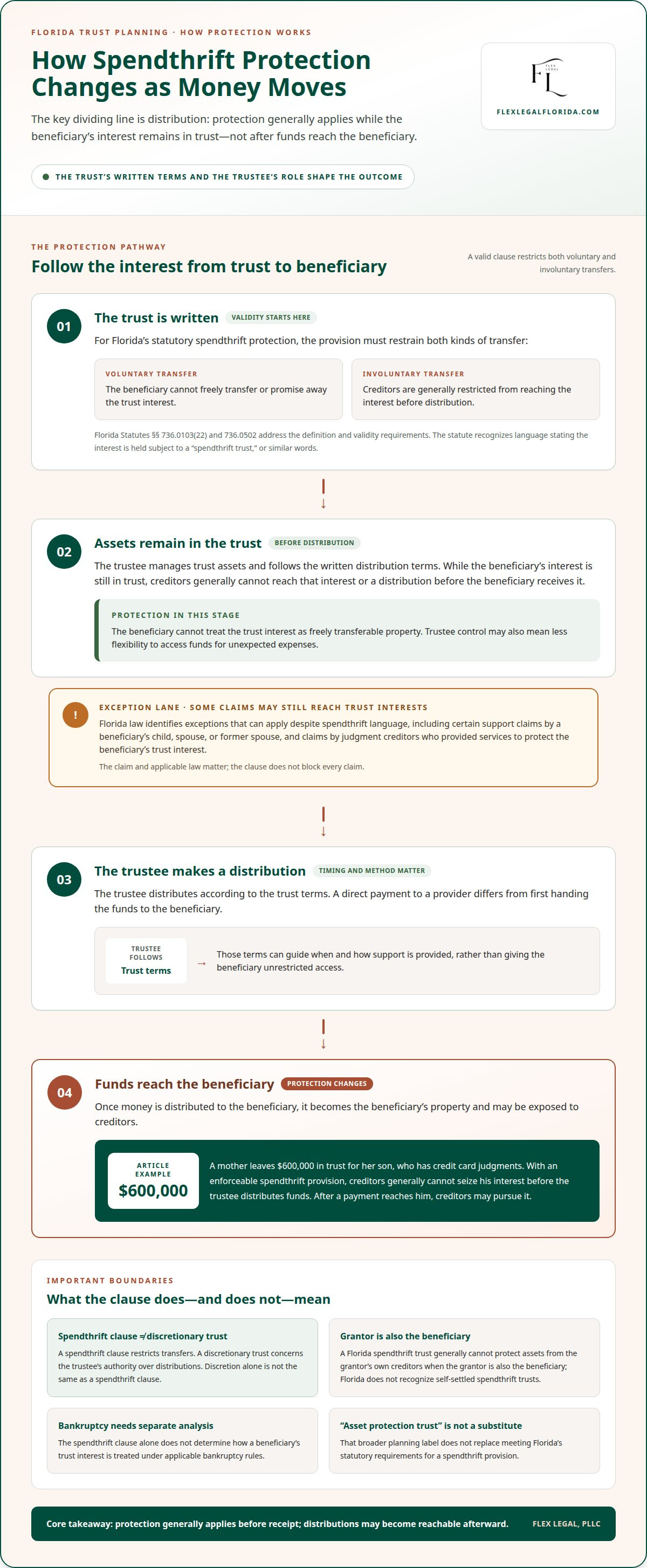
A valid spendthrift provision blocks a beneficiary from transferring their interest and generally keeps creditors from reaching it before distribution. According to The Florida Legislature, a beneficiary may not transfer an interest contrary to a valid spendthrift provision, and creditors generally cannot reach the interest or distribution before receipt. This matters when an inheritance stays under trustee control: creditors and assignees generally cannot take the beneficiary’s interest while assets remain in trust. Once money is distributed to the beneficiary, it becomes their property and may be exposed to creditors.
Creditor Access Without Spendthrift Language
Without enforceable spendthrift language, the trust lacks this specific barrier to transfers and creditor claims. Florida law requires the provision to restrain both voluntary and involuntary transfers for statutory protection to apply. A beneficiary might otherwise promise an interest to someone else, while creditors may seek access through legal claims. Other trust terms still matter, including whether distributions are discretionary, but discretion alone is not the same as a spendthrift clause. This distinction can affect how well the trust keeps an inheritance separate from a beneficiary’s debts.
Inheritance and Creditor Judgments
Consider a mother who leaves $600,000 in trust for her son, who has credit card judgments against him. If the trust contains an enforceable spendthrift provision, creditors generally cannot seize his interest before the trustee distributes funds. The trustee follows the trust terms and controls when distributions occur. That timing matters: once a payment reaches the son, it becomes his property and creditors may pursue it. A trustee’s direct payment to a provider also differs from handing funds to the beneficiary first. This example shows why the distribution method can affect practical protection.
Limits on Creditor Protection
Spendthrift protection has exceptions. Florida law allows certain support claims by a beneficiary’s child, spouse, or former spouse, as well as claims by judgment creditors who provided services to protect the beneficiary’s trust interest. A discretionary trust concerns the trustee’s authority over distributions; a spendthrift clause restricts transfers. “Asset protection trust” is a broader planning label, not a substitute for meeting Florida’s statutory requirements.
A Florida spendthrift trust generally cannot protect assets from the grantor’s own creditors if the grantor is also the beneficiary; Florida does not recognize self-settled spendthrift trusts. Bankruptcy treatment also requires separate analysis: the clause alone does not determine how a beneficiary’s trust interest is treated under applicable bankruptcy rules.
Definition and purpose of a spendthrift trust
A spendthrift trust combines trustee management with a restriction on transferring a beneficiary’s interest. The spendthrift provision itself does not determine a tax outcome or setup cost; drafting needs, trust assets, distribution terms, and each party’s role shape those questions.
Florida Definition and Validity Requirements
Florida defines a spendthrift provision as a trust term that restrains both voluntary and involuntary transfers of a beneficiary’s interest. That definition, in Florida Statutes section 736.0103(22), matters because the required restraints determine whether the provision qualifies under state law. Under section 736.0502, both types of transfer must be restricted for a provision to be valid. Language stating that an interest is held subject to a “spendthrift trust,” or similar words, satisfies the statutory requirement. A lawyer drafting an estate plan must account for these terms in the trust document.
How a Spendthrift Provision Operates
A spendthrift provision limits transfers of a beneficiary’s interest and guides how the trustee handles trust assets. It matters because the beneficiary cannot treat the trust interest as freely transferable property. The trustee follows the distribution terms rather than giving the beneficiary unrestricted access. For example, a trust may provide income over time instead of leaving the beneficiary with one large distribution. The clause’s effect depends on the written terms and the trustee’s role in carrying them out.
The purpose is to combine financial support with limits on direct control. A parent creating an estate plan might want a beneficiary to receive ongoing support without managing the entire inheritance at once. That arrangement can address concerns about financial judgment while keeping decisions within the trust’s framework. It also means the beneficiary may have less flexibility to use funds outside the stated terms.
To align a spendthrift provision with broader estate goals, consider Florida estate planning support.
Exceptions for certain support and service-related claims
A spendthrift clause does not block every claim against a beneficiary’s trust interest. Florida Statutes section 736.0503 identifies exceptions that can matter even when a provision restricts voluntary and involuntary transfers. Knowing these limits helps families shape an estate plan around both the beneficiary’s needs and potential legal obligations.
Support claims are a key exception. Florida law allows certain claims by a beneficiary’s child, spouse, or former spouse, including claims connected to support or maintenance. An enforceable child support order may reach trust assets despite spendthrift language. Alimony claims can also raise issues under these exceptions. The outcome depends on the claim and applicable law, not simply on whether the trust contains a protective clause.
A separate exception concerns judgment creditors who provided services to protect the beneficiary’s interest in the trust. This is narrower than a rule allowing every creditor to collect. For example, a creditor with a judgment for services that preserved or protected that trust interest may have a claim against it. Ordinary unpaid bills or unrelated debts do not automatically fit this service-related category.
Government claims may also limit protection. A spendthrift provision may not be enforceable against claims by Florida or the United States to the extent state or federal law permits those claims. The clause therefore cannot promise blanket protection from public obligations.
For an estate plan, these distinctions affect how a trustee responds to a support order, a judgment, or a government claim. The trustee must follow the trust terms while accounting for legally recognized exceptions. An estate planning attorney at Flex Legal, PLLC can assess how the provision interacts with a beneficiary’s circumstances and the nature of a claim. A carefully drafted clause can still protect trust assets from many claims before distribution, but its limits should be clear to the people relying on it.
Spendthrift clauses and beneficiary restrictions
A spendthrift clause shapes how a beneficiary can use or transfer a trust interest. Its limits can suit beneficiaries who need ongoing support but should not control an inheritance outright.
Beneficiary Financial Mismanagement
A spendthrift clause can address concerns about a beneficiary’s financial judgment by keeping trust assets under trustee management. For example, a family may use staged distributions rather than giving a beneficiary the full inheritance at once. This approach may help someone prone to impulsive spending or who struggles to manage financial affairs. The trust document sets the distribution conditions, so protection and support work together through defined terms.
Beneficiary Access and Flexibility
Beneficiary access depends on the trust document’s distribution terms and the trustee’s authority. A trust may provide funds in increments, set an annual amount, or allow distributions for health, education, maintenance, and support. That structure can help a beneficiary with ongoing needs, including someone whose future care requires planning. It also limits flexibility: the beneficiary may not be able to draw extra funds for an unexpected expense if the terms do not allow it.
Limits on Transfers and Withdrawals
The Florida Legislature states that a beneficiary may not transfer an interest contrary to a valid spendthrift provision, and creditors generally cannot reach the interest or a distribution before the beneficiary receives it. The trustee makes distributions according to the trust document. Once received, a distribution becomes the beneficiary’s property. A spendthrift trust is typically irrevocable, so its terms can have lasting effects. Clear language matters: estate planning should balance protection from a beneficiary’s financial missteps with practical access to support.
For guidance on shaping distribution terms around a beneficiary’s needs, discuss trust planning options.
Flex Legal, PLLC: Revocable Living Trusts
Flex Legal, PLLC helps Florida families shape estate plans through Revocable Living Trusts, with terms tailored to their goals and beneficiaries. If you’re considering how a trust should manage assets or coordinate with a spendthrift provision, discuss the plan as a whole. Trust Administration Assistance can help trustees carry out an established trust’s terms. For families planning around a beneficiary with a disability, Special Needs Planning can address how future support fits into the broader estate plan.
The right structure depends on who creates the trust, who benefits, and how distributions should work. Contact Flex Legal, PLLC to discuss your trust planning needs in West Palm Beach.
Make Your Estate Plan Fit Your Family
Understanding what a spendthrift trust in Florida can and cannot do is a starting point, not the whole plan. Next, consider how the beneficiary’s circumstances, distribution needs, and other estate planning documents fit together. A trust designed around one person’s needs may not suit another beneficiary or remain appropriate after family circumstances change.
That broader perspective can clarify whether a trust belongs alongside other planning measures, such as Guardianship, and how the pieces should work together. Flex Legal, PLLC helps West Palm Beach families consider these planning needs and develop an approach suited to their goals.
If you’re ready to discuss your estate plan, contact Flex Legal, PLLC. A thoughtful conversation can help you identify the next step with greater clarity.
Frequently Asked Questions
Are There Potential Drawbacks?
Yes. Understanding what a spendthrift trust in Florida can do also means weighing its limits on beneficiary access. A beneficiary may not be able to use funds on short notice, even for an unexpected expense, because the trustee must follow the trust terms. For example, scheduled payments may not allow an extra distribution for an urgent purchase. Consider the beneficiary’s financial habits alongside their need for flexibility.
How do I add a spendthrift provision to my estate plan?
Have the provision drafted into the trust document, with language addressing both voluntary and involuntary transfers. The document should also explain how the trustee handles distributions and what support the beneficiary may receive. For a West Palm Beach estate plan, these terms should fit the family’s goals and the beneficiary’s circumstances, rather than being added as a standalone phrase without considering the rest of the trust.
What is a spendthrift trust under Florida law?
To understand what a spendthrift trust in Florida is, look at both its transfer restrictions and its distribution terms. Florida Statutes section 736.0103(22) defines a spendthrift provision as restraining voluntary and involuntary transfers. The trust document sets the trustee’s role and how distributions work. This structure can help families manage how an inheritance is received instead of giving a beneficiary immediate, unrestricted control.
How does a spendthrift provision protect trust assets from creditors in Florida?
Before a beneficiary receives a distribution, creditors generally cannot reach the beneficiary’s trust interest when a valid spendthrift provision applies. Florida Statutes section 736.0502 governs these provisions, while section 736.0504 addresses discretionary distributions. A creditor generally cannot force the trustee to make a discretionary payment. Once funds reach the beneficiary, however, they become the beneficiary’s property and may be exposed to creditor claims.
What are the exceptions to spendthrift protection in Florida, including child support and alimony?
Florida Statutes section 736.0503 recognizes exceptions that can include certain support claims by a beneficiary’s child, spouse, or former spouse. Claims by judgment creditors who provided services protecting the beneficiary’s trust interest may also qualify. Government claims can present additional limits to the extent state or federal law permits. The type of claim matters, so a support order or judgment should not be treated as automatically barred by the trust clause.
What requirements must a Florida trust meet for a valid spendthrift provision?
The provision must restrain both voluntary and involuntary transfers of the beneficiary’s interest. Florida Statutes section 736.0502(2) says language stating that the interest is held subject to a “spendthrift trust,” or similar wording, satisfies the requirement. The trust document should connect that restriction with clear distribution terms and trustee duties, so the provision works as part of the trust rather than as an isolated label.



Comments