
Special Needs Trust for Fragile X: How It May Help with Medicaid and SSI

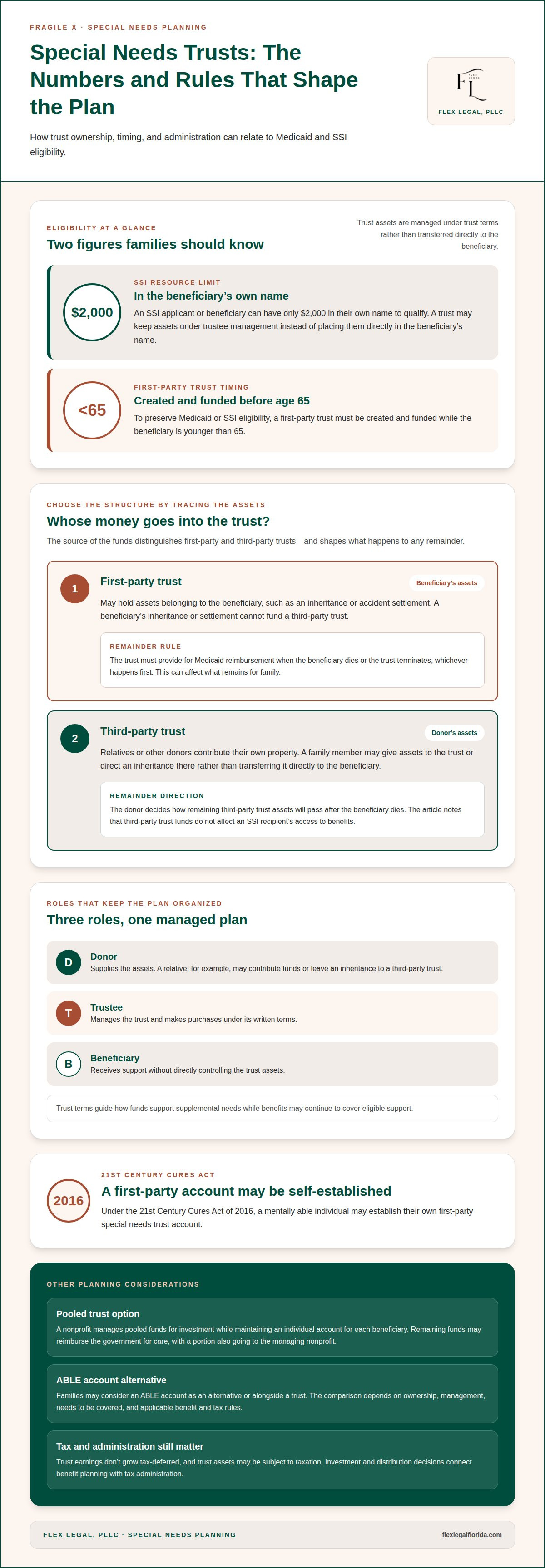
A special needs trust for Fragile X syndrome may let a person receive trust support while preserving access to needs-based benefits such as Medicaid and Supplemental Security Income (SSI). In the United States, an SSI applicant or beneficiary can have only $2,000 in their own name to qualify, and a first-party trust must be created and funded before the beneficiary turns 65 to preserve Medicaid or SSI eligibility, according to the U.S. House Office of the Law Revision Counsel.
Families often want to provide meaningful support without unintentionally disrupting benefits. A third-party trust can hold funds contributed by relatives or others, while a first-party trust may hold assets belonging to the beneficiary, such as an inheritance or settlement. The rules and consequences differ, so the trust’s design matters.
This article explains how a special needs trust for Fragile X syndrome may relate to Medicaid and SSI eligibility, how third-party trusts work, and what to understand about creditor exposure. It also outlines how trust terms, funding, and administration shape the plan, helping families identify where thoughtful legal planning can fit.
Table of Contents
What's a Special Needs Trust For, and How Can It Help?
A special needs trust can hold assets for a person with disabilities while coordinating support with government programs such as SSI and Medicaid. Trust rules differ by state, so Florida families can work with a local estate-planning attorney to align the document with applicable rules.
Preserving and Supplementing Public Benefits
A trust may help preserve benefits by keeping assets under trustee management rather than giving them directly to the beneficiary. This matters because SSI eligibility limits what a person may own: an applicant or beneficiary can have only $2,000 in their own name to qualify. The trustee can use trust funds for supplemental needs, helping benefits continue to cover eligible support while trust resources address other needs.
Earmarking Assets for a Beneficiary
Earmarking means setting aside property for a beneficiary’s needs under written trust terms. The main types differ by who owns the funds: a first-party trust may hold the beneficiary’s inheritance or accident settlement, while a third-party trust holds assets from relatives or other donors. For a first-party special needs trust to preserve Medicaid or SSI eligibility, the beneficiary must be younger than 65 when the trust is created and funded, according to the U.S. House Office of the Law Revision Counsel. Trust terms also guide how remaining assets are handled.
Donor, Trustee, and Beneficiary Roles
A donor supplies the assets, a trustee manages them, and the beneficiary receives support. For example, a relative can contribute funds while a trustee makes purchases for the beneficiary under the trust’s terms. Clear roles matter throughout the beneficiary’s lifetime: the donor’s contribution is set aside, the trustee administers it, and the beneficiary receives support without directly controlling the trust assets.
ABLE Accounts and Trust Alternatives
An ABLE account is another way to set aside resources for a person with disabilities, while a special needs trust holds assets managed under trustee-directed terms. The comparison depends on who owns the funds, how they will be managed, and which needs they should cover. Families may consider an ABLE account as an alternative or alongside a trust, with benefit and tax rules informing the arrangement.
How special needs trusts may help protect eligibility for Medicaid and SSI
A trust can keep assets under fiduciary management instead of placing them directly in an individual’s name. That distinction matters when income and resources affect access to Medicaid or SSI. For children and adults with Fragile X syndrome, trust terms can direct funds toward supplemental needs while preserving a structure designed around benefit rules. Both the trustee’s decisions and the source of the funds matter.
First-party trusts hold assets that belong to the beneficiary, such as an inheritance or settlement. Their terms must address Medicaid repayment: when the beneficiary dies, remaining assets may reimburse the government for medical care. A first-party trust must provide for Medicaid reimbursement when the beneficiary dies or the trust terminates, whichever happens first. This requirement affects what may pass to family afterward.
Parents and other individuals may also consider pooled trusts. A nonprofit manages the pooled arrangement, combining funds for investment while maintaining an individual account for each beneficiary. Remaining funds may reimburse the government for care, with a portion also going to the managing nonprofit. This structure may suit families who do not choose a separate trust.
Tax treatment is another planning point. Earnings in a special needs trust don’t grow tax-deferred, and trust assets may be subject to taxation. The trustee’s investment and distribution decisions therefore connect benefit planning with tax administration. A trust can preserve a pathway to programs, but it doesn’t make tax obligations disappear.
Under the 21st Century Cures Act of 2016, a mentally able individual may establish their own first-party special needs trust account. For families weighing trust terms, repayment provisions, and ongoing administration, special needs planning can help connect these decisions into one coordinated plan.
Third-party special needs trusts
A third-party trust lets relatives or other donors reserve assets for a beneficiary without using that person’s own funds. Its funding source and remainder terms distinguish it from a first-party trust.
Distinguishing Third-Party and First-Party Trusts
The key distinction is whose assets fund the trust: a third party contributes their own property, while a first-party trust holds assets belonging to the beneficiary. A beneficiary’s inheritance or settlement cannot fund a third-party trust. This difference matters because third-party trust funds don’t affect an SSI recipient’s access to benefits, including Supplemental Security Income. A first-party trust, by contrast, has a Medicaid payback requirement that affects what happens to remaining assets.
Funding a Third-Party Trust
Family members can contribute gifts or leave an inheritance to a third-party trust instead of transferring assets directly to the beneficiary. For example, a relative’s will can direct a bequest into a testamentary trust. Created under the will and funded after the will-maker dies, this can only be a third-party trust. A stand-alone trust can also be established during the donor’s lifetime. It may be revocable or irrevocable, so the donor’s chosen structure affects how the arrangement is managed.
Distributing the Trust Remainder
The donor decides how remaining third-party trust assets will pass after the beneficiary dies. The trust terms can name family members or a charity, giving the donor control over the eventual distribution. Unlike a first-party trust, a third-party trust has no government Medicaid payback provision. A properly drafted trust can continue after the donor’s death, allowing a trustee to administer the assets for the beneficiary. This planned remainder can help families coordinate lifetime support with a future inheritance for others.
How do you establish and fund a special needs trust for a child or adult with Fragile X syndrome?
An attorney begins by identifying who owns the assets and what the trust must support. That distinction separates a first-party trust, funded with the beneficiary’s assets, from a third-party trust funded by someone else. The attorney can then shape trust terms around the beneficiary’s needs, benefit eligibility, and intended funding sources.
For a first-party trust, the beneficiary’s assets may include an inheritance or settlement. The trust must be irrevocable, and a parent, grandparent, guardian, or court may establish it. The beneficiary must be younger than 65 when it is created and funded to preserve Medicaid or SSI eligibility. Its terms must also address Medicaid reimbursement.
A third-party trust uses assets belonging to relatives or other donors, not the beneficiary. It can be established during the donor’s lifetime or through an estate plan that takes effect after the donor’s death. For example, a will can direct an inheritance into a testamentary special needs trust. The attorney coordinates that direction with the donor’s broader estate documents.
Families may also consider a pooled trust. A nonprofit establishes and manages it, combining funds for investment while maintaining a separate account for each beneficiary. The attorney can compare this structure with an individual trust based on the asset source and intended administration. Each option has different remainder provisions and management arrangements.
Trust documents typically require two witnesses and notarization, subject to applicable state guidelines. Because trust rules differ by state, an attorney can prepare documents for the relevant jurisdiction and coordinate funding language with wills and other estate-planning documents. The trustee’s role and permitted distributions should also be clearly defined.
For a child or adult with Fragile X syndrome, professional planning can align the trust’s structure, funding source, and administration. Discuss special needs trust planning to develop an approach suited to the beneficiary and family’s estate plan.
Flex Legal, PLLC: Special Needs Planning
Flex Legal, PLLC helps West Palm Beach families plan for a loved one with Fragile X through Special Needs Planning. This is a practical next step when you’re deciding how a trust should be structured, funded, and administered alongside other estate documents.
A coordinated plan can connect a special needs trust with a Revocable Living Trust or a Designation of Pre-need Guardian where those documents fit the family’s goals. Trust Administration Assistance can also support ongoing trust management. The right combination depends on the beneficiary’s needs, the source of funds, and the family’s wishes for future care and support.
If you’re ready to discuss planning for a family member, contact Flex Legal, PLLC.
Make a Plan That Can Adapt Over Time
A plan for a loved one with Fragile X should reflect more than today’s needs. Family roles, sources of support, and long-term priorities can change. A special needs trust for Fragile X syndrome works best as part of a broader plan that connects those decisions and gives the people involved a clear framework to follow.
Flex Legal, PLLC offers Special Needs Planning alongside Revocable Living Trusts and Guardianship Proceedings. These services can help families coordinate trust planning with decisions about who will support a loved one and how that support should continue. Discuss your family’s priorities and the planning questions that matter most with Flex Legal, PLLC in West Palm Beach.
Contact Flex Legal, PLLC to discuss your options. Thoughtful planning can give your family a clearer path forward.
Frequently Asked Questions
Why Are There Different Types of SNTs?
Different trust types address different funding sources, administration needs, and plans for remaining assets. For example, a beneficiary’s settlement calls for different planning than a parent’s intended gift. A pooled trust also uses nonprofit management and combines funds for investment while maintaining separate beneficiary accounts. These distinctions help families choose a structure that reflects the source of funds and how support should be managed.
What is a special needs trust and how can it benefit someone with Fragile X syndrome?
A special needs trust for Fragile X syndrome holds and manages assets for a person with disabilities under written trust terms. A trustee can coordinate supplemental support with government benefits rather than handing trust funds directly to the beneficiary. The trust can also specify who manages the assets and how they should be used, helping relatives plan for ongoing support and future administration.
What types of special needs trusts are available: first-party, third-party, and pooled?
The main types are first-party, third-party, and pooled trusts. A first-party trust holds assets belonging to the beneficiary. A third-party trust holds assets contributed by someone else, such as a relative. A nonprofit manages a pooled trust, combining funds for investment while keeping an account for each beneficiary. Their funding and remainder provisions differ, so the source of assets helps distinguish them.
Which trust is appropriate for a person with Fragile X syndrome who receives SSI or Medicaid?
The appropriate structure depends first on who owns the funds. A settlement belonging to the beneficiary points toward first-party planning, while a family member’s gift or inheritance can be directed to a third-party trust. For a person with Fragile X syndrome, choosing a special needs trust means considering how its administration and remainder terms fit the funding source and support plan. A pooled trust is another option, managed by a nonprofit.
How does a special needs trust affect SSI eligibility and monthly benefits?
A properly structured trust can hold assets for supplemental needs without placing them directly in the beneficiary’s name. That can support SSI eligibility, but the trust does not automatically increase the monthly payment. Distribution choices matter: trust assets cannot be paid to the beneficiary as cash or cash-like items, such as gift cards or prepaid cards. The trustee follows the trust terms when arranging support.
How does a special needs trust affect Medicaid eligibility and coverage?
A special needs trust can help preserve Medicaid eligibility while providing supplemental support, but it doesn’t replace Medicaid or expand the program’s covered services. Trust type matters. A first-party trust must address reimbursement for Medicaid care from remaining assets when the beneficiary dies or the trust terminates, whichever happens first. A third-party trust has no equivalent Medicaid payback provision, so its remainder can follow the donor’s instructions.

Comments