
Special Needs Planning Attorney in West Palm Beach: A 2026 Guide for Families

Updated: Apr 15
What if the financial safety net you've spent years building for your child is the very thing that disqualifies them from essential healthcare? This "benefit cliff" is a reality for families in Palm Beach County, where even a small inheritance can trigger a total loss of SSI or Medicaid eligibility. Partnering with a special needs planning attorney ensures your legacy provides support rather than creating a crisis. You want to provide a comfortable life for your loved one, but the fear of losing their government support feels like a constant weight. It's a stressful balance to maintain alone, especially with Florida's intricate probate and guardianship regulations.
This 2026 guide provides a clear roadmap to protect your family's assets while ensuring your loved one remains fully covered by state support systems. We'll break down the latest updates to Florida law and show you how to implement flexible legal tools, such as Third-Party Special Needs Trusts and modernized ABLE accounts. You'll discover how to secure your loved one's financial future and protect their essential government benefits with modern legal strategies that provide lasting peace of mind. Our goal is to replace legal confusion with a strategic, agile plan that evolves with your family's needs.
Key Takeaways
Avoid the "2,000 Dollar Trap" by learning how Florida asset limits work and why traditional disinheritance is a dangerous mistake for your family’s future.
Compare the benefits of Special Needs Trusts and ABLE accounts to determine the most flexible and tax-efficient financial strategy for your loved one's unique needs.
Master the "3 Pillars" of a complete plan, from navigating Palm Beach County guardianship proceedings to drafting a comprehensive Letter of Intent for future caregivers.
Discover how a special needs planning attorney provides a seamless path through complex court filings and asset protection with a modern approach tailored to West Palm Beach families.
Table of Contents Why Special Needs Planning is Essential for Palm Beach County Families Understanding Special Needs Trusts (SNTs) in Florida ABLE Accounts vs. Special Needs Trusts: Which Fits Your Family? Beyond the Trust: The 3 Pillars of a Complete Special Needs Plan How a West Palm Beach Special Needs Planning Attorney Simplifies the Process
Why Special Needs Planning is Essential for Palm Beach County Families
Securing the future of a loved one with disabilities involves more than just financial preparation. It requires a deep understanding of how state and federal systems interact. In West Palm Beach, families often feel the heavy emotional weight of ensuring a lifetime of care. A special needs planning attorney acts as a strategic ally, helping you design a roadmap that balances compassion with strict legal compliance. As we move into 2026, Florida's regulatory environment requires proactive adjustments to ensure benefits remain intact and your family's legacy is protected.
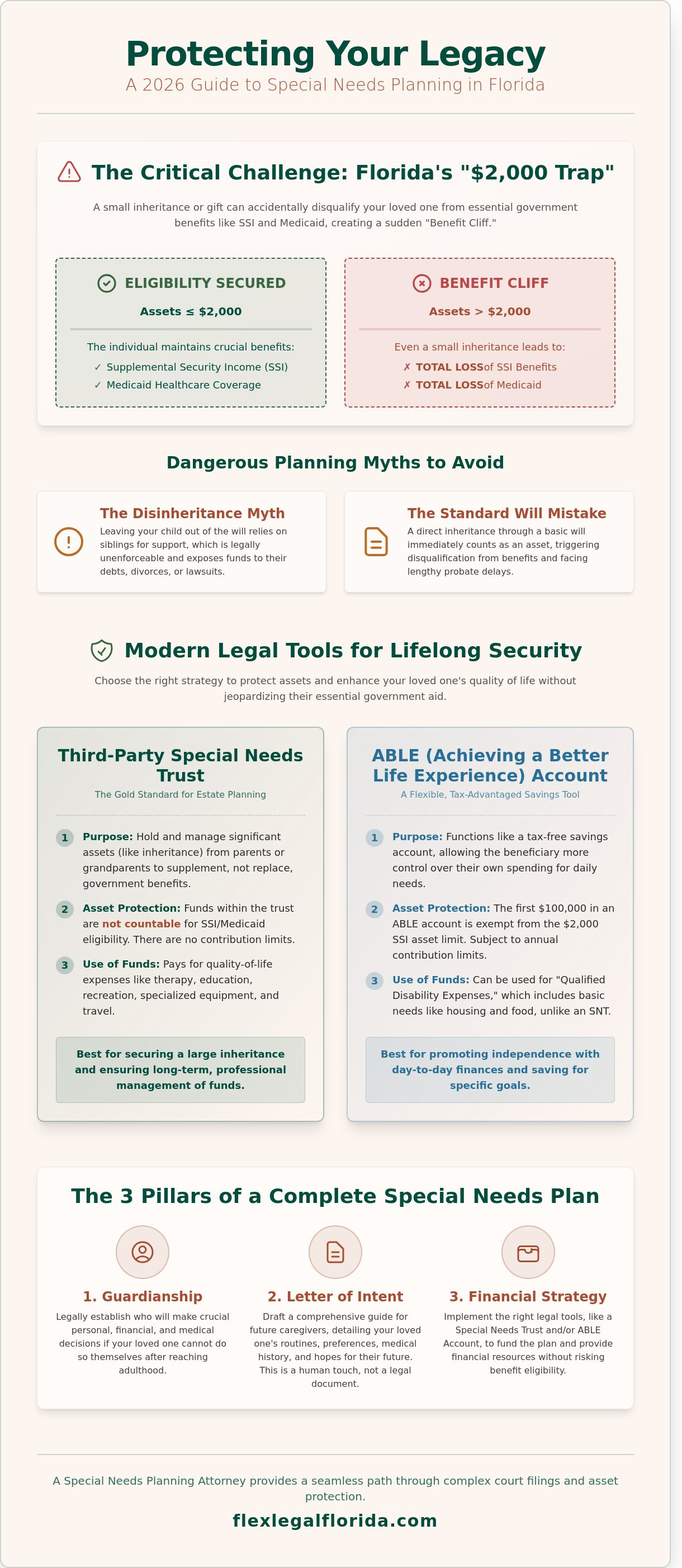
Many families unknowingly fall into what experts call the 2,000 dollar trap. This occurs when a well-meaning relative leaves a small inheritance or cash gift directly to a person with a disability. In Florida, even a modest surplus can trigger an immediate loss of Supplemental Security Income (SSI) and Medicaid. Medicaid eligibility in Florida requires strict adherence to asset thresholds, often capped at $2,000 for individuals. This threshold is incredibly low, making professional planning vital to prevent a sudden loss of essential healthcare and housing support.
The Impact of Inheritance on SSI and Medicaid
A sudden influx of cash can be devastating for a resident receiving assistance through the Florida Agency for Health Care Administration (AHCA). Florida law distinguishes between countable assets, such as savings accounts or stocks, and non-countable assets, like a primary residence or a single vehicle. To protect these benefits while providing for a loved one's quality of life, families often utilize a Special Needs Trust. This legal tool allows funds to be used for supplemental needs without counting toward the $2,000 limit. It ensures your child has access to therapy, specialized equipment, or recreation without sacrificing their baseline medical coverage.
Why a Standard Will Isn't Enough
Relying on a basic will is a dangerous mistake for families in Palm Beach County. Outright distributions to a beneficiary with a disability create an immediate disqualification from state programs. Some parents attempt to solve this by disinheriting their child entirely, hoping siblings will provide support. This disinheritance myth is risky; it leaves the person with a disability vulnerable to the siblings' creditors, lawsuits, or personal financial crises.
Additionally, Florida probate can delay the distribution of assets for 6 to 12 months, leaving a significant gap in care. Working with a special needs planning attorney allows you to implement modern solutions that bypass these hurdles. A comprehensive plan often incorporates a revocable trust to provide immediate, seamless support. This approach ensures that your loved one's care continues without interruption, regardless of changes in the legal landscape or family dynamics.
Understanding Special Needs Trusts (SNTs) in Florida
A Special Needs Trust (SNT) serves as a strategic financial shield for your family. It allows a person with a disability to benefit from inherited or awarded funds without losing access to critical government assistance. In Florida, programs like Supplemental Security Income (SSI) and Medicaid have strict asset limits. As we look toward 2026, the individual resource limit remains capped at $2,000 for most applicants. Going even a dollar over can trigger a total loss of benefits. An SNT solves this by holding assets in a way that the state doesn't count toward that limit.
The "supplemental" rule is the heart of this arrangement. Trust funds don't replace government help; they enhance it. While SSI typically covers basic needs like food and shelter, the trust pays for quality-of-life items that Medicaid doesn't cover. This includes advanced dental care, specialized mobility equipment, travel for family visits, or even home comfort enhancements from Standard Insulation. It’s a tailored approach that ensures your loved one doesn't just survive but thrives. This distinction is vital for maintaining a comfortable lifestyle while preserving the safety net of public benefits.
Third-Party SNTs: The Gold Standard for Parents
Parents and grandparents typically use this structure for estate planning to fund a secure future for their heirs. You fund the trust with your own assets through a will or a living trust. This is the most flexible option because it avoids the Florida Medicaid payback provision. Since the money never belonged to the beneficiary, the state has no claim to it after they pass away. Remaining funds can go to siblings or other family members. A special needs planning attorney ensures the trust uses specific "non-countable" language to prevent benefit disqualification. Many families integrate these trusts with ABLE Accounts to provide even more direct access to funds for everyday expenses without affecting their SSI status.
First-Party SNTs: Managing Settlements and Back-Payments
These trusts manage money that already belongs to the person with a disability. This often occurs after a personal injury settlement or a large retroactive Social Security payment. These are strictly governed by federal d4A regulations. Florida law requires these trusts to include a mandatory Medicaid reimbursement clause. This means the state receives a "payback" for medical costs covered during the beneficiary's lifetime once they pass away. While less flexible than third-party options, they are essential for protecting sudden windfalls. Working with a special needs planning attorney helps you navigate these rigid state requirements. This strategic oversight creates a seamless path forward during high-stress financial transitions, ensuring that a lawsuit settlement provides lasting support rather than a loss of essential services.
ABLE Accounts vs. Special Needs Trusts: Which Fits Your Family?
Special needs planning isn't a one-size-fits-all process. In 2026, Florida families have more options than ever to protect a loved one's future. The choice often comes down to balancing the immediate flexibility of an ABLE account with the robust protection of a trust. A special needs planning attorney helps you determine which tool, or combination of tools, secures the best outcome for your specific situation.
The Benefits of a Florida ABLE Account
Florida's ABLE United program provides a tax-advantaged way to save for disability-related expenses without losing government benefits. As of January 1, 2026, the ABLE Age Adjustment Act has fully expanded eligibility to individuals who developed their disability before age 46. This is a significant jump from the previous age 26 limit. Funds in these accounts grow tax-free and don't count toward the $2,000 SSI asset limit as long as the total balance stays under $100,000. These accounts provide daily autonomy. Beneficiaries can often use a linked debit card for qualified expenses like transportation, housing, or health co-pays without waiting for a trustee's approval.
When a Special Needs Trust is Necessary
While ABLE accounts are convenient, they have strict annual contribution limits. For 2026, the standard limit is $18,000, though working beneficiaries may contribute more. This makes them insufficient for handling a $500,000 life insurance payout or the title to a family home. A trust has no upper limit on assets and provides a structured framework for long-term management. You should consult an attorney for special needs trust to draft a document that ensures a professional or family trustee can manage complex assets while maintaining eligibility for Medicaid.
Most West Palm Beach families find that using both tools in tandem creates the most resilient plan. You can use a trust to hold the bulk of an estate while periodically funding an ABLE account for the beneficiary's personal use. Following the 4 Essential Steps in Special Needs Planning ensures you don't overlook these critical financial resources. This strategic approach provides the safety of a trust with the agility of a modern savings account. Using both allows for a seamless transition of wealth while providing the beneficiary with a sense of financial independence.
ABLE Accounts: Best for modest savings, daily expenses, and beneficiary control.
Special Needs Trusts: Essential for large inheritances, real estate, and long-term oversight.
The Hybrid Approach: Maximizes tax benefits while protecting unlimited asset amounts.
Beyond the Trust: The 3 Pillars of a Complete Special Needs Plan
A Special Needs Trust serves as the financial engine of your strategy, but it cannot drive itself. A comprehensive plan requires a framework that addresses daily care, legal authority, and long term quality of life. Working with a special needs planning attorney allows you to build these three pillars, ensuring your child's transition into adulthood is handled with dignity and precision rather than bureaucratic friction.
Guardianship and Its Alternatives in Florida
When a child with a disability turns 18, Florida law views them as a legal adult. This shift can complicate a parent's ability to make medical or financial decisions. In Palm Beach County, families often utilize Guardian Advocacy under Florida Statute 393.12. This is a streamlined process designed specifically for individuals with intellectual or developmental disabilities. It doesn't require a suggestion of "incapacity," which makes it a less invasive and more respectful option than traditional plenary guardianship.
The Palm Beach County Clerk of Court maintains strict oversight of these proceedings. You'll need to submit annual simplified reports to ensure the ward's needs are being met. However, legal authority isn't always all-or-nothing. We often explore less restrictive alternatives such as:
Durable Power of Attorney: Grants specific decision-making powers without court intervention.
Healthcare Surrogate Designations: Ensures you can still talk to doctors and access medical records.
Supported Decision-Making (SDM) Agreements: A modern approach where the individual retains their rights but chooses a team to help them understand and make choices.
The Letter of Intent: Your Loved One's Roadmap
While the trust and guardianship papers handle the "how" of legalities, the Letter of Intent handles the "who" of your child's life. This document functions as an evolving instruction manual for future caregivers and trustees. It captures the nuances that legal forms miss, such as specific medical histories, preferred social activities, and even dietary quirks that keep your child comfortable. The Letter of Intent is a non-binding but critical guide for future trustees.
By documenting daily routines and personal preferences now, you prevent a future crisis of care. This roadmap acts as the most valuable gift you can leave, providing a seamless transition that maintains your child’s emotional stability. It's also vital to coordinate this plan with local West Palm Beach resources, such as the Arc of Palm Beach County or the Els Center for Excellence, to ensure your child remains connected to their community.
For families who want to ensure their child also has access to specialized psychological support, Florida-based resources like balanced-minds.com can provide the ongoing mental health care necessary for a high quality of life.
Selecting a Trustee: The Flexibility Factor
Choosing between a family member and a professional trustee is a strategic decision. A family member brings personal love and insight, but they may lack the expertise to navigate complex SSI and Medicaid resource limits. Professional trustees offer reliability and technical knowledge but may lack a personal connection. Many West Palm Beach families opt for a hybrid approach, appointing a professional to handle the math and a "Trust Protector" or family co-trustee to handle the personal touch. This creates the flexibility needed to adapt as laws change.
Ready to build a resilient future for your family? Contact a special needs planning attorney at Flex Legal Florida to start your customized plan today.
How a West Palm Beach Special Needs Planning Attorney Simplifies the Process
Planning for a loved one with a disability often feels like a full-time job. Families in Palm Beach County face a unique set of challenges, from complying with the 15th Judicial Circuit Court requirements to protecting assets under Florida's specific trust laws. A special needs planning attorney acts as your guide, removing the friction from these complex legal decisions. Flex Legal shifts the focus from rigid, outdated paperwork to a modern, empathetic strategy that adapts to your family's life.
Tailored Strategies for West Palm Beach Residents
Effective planning doesn't happen in a vacuum. Your efforts to protect a child or sibling must align with your broader estate planning goals to ensure your entire financial legacy remains intact. Flex Legal serves as an agile ally for busy Florida parents who need efficiency without sacrificing quality. We ensure every document, from a Third-Party Special Needs Trust to a Letter of Intent, meets the latest 2026 Florida statutory requirements.
Local expertise matters because Palm Beach County court filings for guardianships or trust accountings require precision to avoid costly delays. Our team streamlines this by using flat-fee packages and transparent communication. You'll always know the status of your plan without worrying about hidden hourly bills or unpredictable costs. This transparent approach allows you to focus on your family's daily needs while we handle the technical legal architecture.
Take the First Step Toward Peace of Mind
You don't need a massive inheritance to start this process. In fact, starting early is vital even if your current assets are modest. A single consultation with a special needs planning attorney can clarify the confusion surrounding SSI and Medicaid eligibility immediately. We help you understand how to structure even small gifts or insurance payouts so they don't accidentally disqualify your loved one from essential government benefits.
The goal is to provide a clear, flexible path forward. By choosing a partner who values speed and modern communication, you can secure your family's future while staying focused on the present. You deserve a legal team that understands the emotional weight of these decisions and treats your case with the urgency it requires. We prioritize clarity over complexity, ensuring you feel confident in every document you sign.
Ready to protect your loved one? Schedule a consultation with Flex Legal today to begin building a secure future for your family.
Take Control of Your Family's 2026 Legacy
Planning for a loved one with disabilities isn't just about paperwork; it's about permanent peace of mind. By the end of 2025, Florida's Medicaid landscape will likely shift again, making the balance between ABLE accounts and Special Needs Trusts even more critical for asset protection. You've seen how the three pillars of a complete plan ensure that SSI benefits remain intact while providing a high quality of life. Navigating these Florida-specific statutes requires more than a template. It demands a partner who understands the local nuances of Palm Beach County courts and the 2026 regulatory environment.
Partnering with a special needs planning attorney allows you to move from uncertainty to a concrete strategy. At Flex Legal Florida, we've replaced the rigid, hourly billing of the past with modern, flat-fee estate planning packages. Our team provides agile and empathetic support to protect your family's eligibility for essential government programs. We focus on clarity and efficiency, ensuring your plan is ready for whatever the future brings. Your family deserves a strategy that's as dynamic as your lives are.
You've got the power to build a lasting safety net today.
Frequently Asked Questions
What is the difference between a Special Needs Trust and a Supplemental Needs Trust?
The primary difference lies in the source of the funds used to create the trust. A third-party Supplemental Needs Trust uses assets from parents or relatives, while a first-party Special Needs Trust uses the beneficiary's own money, such as a personal injury settlement. This distinction is vital because first-party trusts require a Medicaid payback provision under 42 U.S.C. 1396p(d)(4)(A).
Third-party trusts don't require you to pay back the state after the beneficiary passes away. This allows you to leave remaining funds to other family members. Choosing the right structure depends on where the money originates and your long-term family goals.
Can a person with a disability have both an ABLE account and a Special Needs Trust in Florida?
You can absolutely have both an ABLE account and a Special Needs Trust at the same time in Florida. These tools work together to maximize financial flexibility. While a trust handles larger assets like real estate or significant investments, a Florida ABLE account allows for up to $18,000 in annual contributions as of 2024 to cover everyday expenses.
Using both strategies provides the best of both worlds. The ABLE account gives the beneficiary more direct control over small purchases. Meanwhile, the trust protects the bulk of the family's wealth for future care needs.
Will my child lose their SSI if I leave them money in my Will?
Your child will likely lose their Supplemental Security Income (SSI) if they inherit more than $2,000 directly through a Will. The Social Security Administration enforces a strict $2,000 individual asset limit for benefit eligibility. To prevent this, a special needs planning attorney can help you restructure your estate plan to direct those funds into a trust.
By using a trust, the assets don't count toward the limit. This keeps your child's benefits secure while providing them with extra financial support. It's a strategic way to ensure they have a high quality of life without sacrificing their basic government safety net.
Who should I choose as a trustee for a Special Needs Trust in West Palm Beach?
Choosing a trustee involves deciding between a trusted family member, a professional corporate trustee, or a pooled trust organization. Many West Palm Beach families select a professional fiduciary to manage the complex tax filings and compliance requirements. This ensures the trust remains in good standing while a family member serves as a trust protector.
The trust protector oversees the beneficiary's personal care and happiness. This partnership approach balances professional financial management with personal, empathetic oversight. It's a reliable way to make sure the trust lasts for the beneficiary's entire lifetime.
How much money can you have in a Special Needs Trust in Florida?
There is no maximum limit on the amount of money you can hold within a Special Needs Trust in Florida. Whether the trust contains $50,000 or $5 million, the assets don't count toward the $2,000 SSI resource limit. This allows families to provide a high quality of life while maintaining eligibility for government programs.
This flexibility is why these trusts are so powerful for long-term planning. You can fund the trust with life insurance policies or retirement accounts to ensure your loved one is cared for. There's no cap on the security you can provide.
What can Special Needs Trust funds be used for without affecting benefits?
Trust funds cover supplemental needs that government benefits don't provide, such as therapy, specialized equipment, or travel. Using funds for housing or food used to reduce SSI payments. However, 2024 policy updates from the Social Security Administration have simplified how food is treated, making it easier to use trust funds for daily comforts.
The trust can pay for electronic equipment, education, and even vehicle modifications. It's designed to provide the "extras" that make life more enjoyable. Your trustee just needs to pay the vendors directly to avoid any issues with benefit calculations.
Is a Special Needs Trust only for children, or can adults use them too?
Special Needs Trusts are designed for both children and adults who live with disabilities. While many parents set them up for minor children, adults who receive a late-onset diagnosis or a legal settlement also use them. It's vital to note that first-party trusts must typically be established before the individual reaches age 65.
Adults often use these trusts to manage an inheritance or a payout from an insurance claim. This ensures they don't lose their Medicaid coverage during a time when they need it most. It's a versatile tool for any stage of life.
Do I need a lawyer to set up a Special Needs Trust in Palm Beach County?
While you aren't legally forbidden from using DIY forms, hiring a special needs planning attorney is the safest way to ensure your trust complies with the Florida Trust Code. The 15th Judicial Circuit in Palm Beach County has specific local requirements for trust administration. A mistake in the trust's language can lead to a permanent loss of benefits.
A lawyer provides a tailored strategy that fits your family's unique situation. They handle the complex paperwork and ensure every clause meets current federal and state laws. This professional support gives you peace of mind that your child's future is secure.


Comments