
Probate Administration for Non-Residents in Florida: How It Works

Probate administration for non-residents in Florida is usually a secondary proceeding for assets located in Florida, alongside the main probate case in the decedent’s home state or country. Under Florida Statutes section 734.102, the Florida court can address local estate property, such as real estate or other assets titled in the decedent’s name. It doesn’t take over the entire estate.
Owning Florida property from abroad can leave a family dealing with two legal systems. If the decedent was not a U.S. citizen, citizenship and country of residence may affect federal estate-tax rules, while another country’s laws may also apply to the estate. This guide explains probate administration for non-residents in Florida, including how ancillary probate works, which Florida assets may be involved, and how the Florida case connects with the primary probate proceeding. It also outlines practical steps for understanding what happens to the property and what the family may need to address.
Table of Contents
What Types of Assets Are Subject to Ancillary Administration?
Florida ancillary administration handles Florida property that remains subject to probate after a nonresident dies. Whether a local proceeding is needed depends on how each asset is owned and titled.
Florida Property Requiring Probate
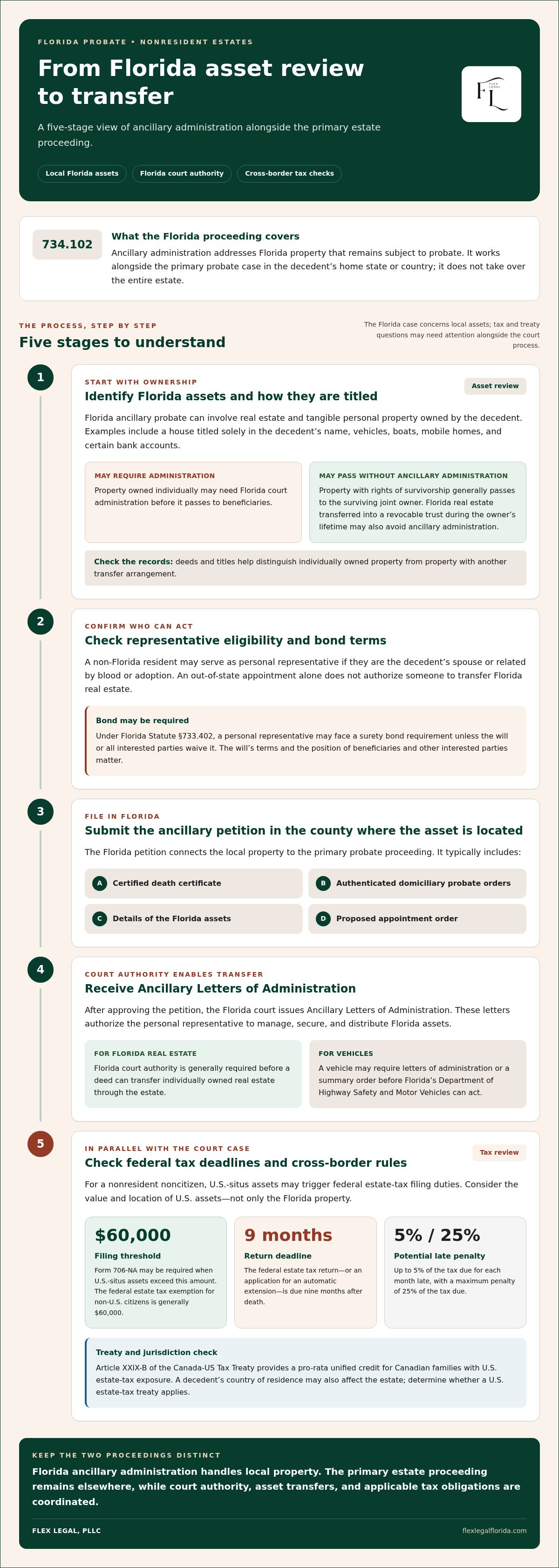
Ancillary probate can cover Florida real estate and tangible personal property owned by the decedent. A house titled solely in the decedent’s name may need court administration before it can pass to beneficiaries. Florida assets can also include vehicles, boats, mobile homes, and certain bank accounts. A vehicle may require letters of administration or a summary order before Florida’s Department of Highway Safety and Motor Vehicles can act.
Assets That May Avoid Ancillary Administration
Some Florida property may pass without ancillary administration because of how it is owned. Property titled jointly with rights of survivorship generally passes to the surviving joint owner when the first owner dies. A nonresident may also avoid ancillary administration for Florida real estate by transferring it into a revocable trust during their lifetime. Review each deed and title to distinguish these assets from property owned individually.
A non-Florida resident may serve as personal representative if they are the decedent’s spouse or related to the decedent by blood or adoption. Eligible relatives may be able to serve as personal representatives even if they live outside Florida. This means an eligible family member may handle the Florida estate without living in the state. The court appointment still matters: out-of-state appointment alone doesn’t authorize someone to transfer Florida real estate.
Florida Statutes Chapter 734 describes powers and requirements for foreign personal representatives. A personal representative may face a surety bond requirement under Florida Statute §733.402, unless the will or all interested parties waive the bond. The will’s terms and the position of beneficiaries and other interested parties therefore affect this part of the appointment. A probate attorney can address the Florida filing and the documents needed for the local proceeding.
What Florida probate assets can avoid ancillary administration for a nonresident? Property passing automatically through rights of survivorship, or Florida real estate transferred into a revocable trust during the owner’s lifetime, may avoid ancillary administration. The title or trust ownership determines how the property passes.
How much do Florida probate filing fees, attorney fees, and personal representative fees cost? Attorney and personal representative fees depend on the case, the work required, estate complexity, and the fee arrangement; pricing is provided after a quote request.
Ancillary Probate Administration in Florida - How Does it Work?
Florida ancillary administration handles Florida assets while the main estate proceeds elsewhere. The petition, court authority, tax questions, and eventual transfer must be coordinated across both proceedings.
Transferring Florida Real Estate
Transferring a nonresident decedent’s individually owned Florida real estate generally requires Florida court authority. An appointment from another state or country does not, by itself, authorize a foreign personal representative to execute a valid deed for Florida property. The ancillary petition is filed in the Florida probate court in the county where the asset is located. It typically includes a certified death certificate, authenticated domiciliary probate orders, details of the Florida assets, and a proposed appointment order.
After approving the petition, the Florida court issues Ancillary Letters of Administration. These letters authorize the personal representative to manage, secure, and distribute the Florida assets. That authority is necessary before a deed can transfer real estate through the estate. The Florida proceeding addresses local property; it does not reopen or decide the entire domiciliary estate.
Risks and Tax Considerations
The key risks and tax considerations include missed federal filing duties, penalties, and conflicting requirements across jurisdictions. A nonresident decedent’s U.S.-situs assets may trigger Form 706-NA filing when they exceed $60,000, according to the Internal Revenue Service. The federal estate tax exemption for non-U.S. citizens is generally $60,000. That threshold makes it important to determine the value and location of U.S. assets, not just the value of Florida real estate.
The Internal Revenue Service sets the federal estate tax return deadline for a nonresident noncitizen’s estate, or an application for an automatic extension, at nine months after death. A late return may incur a penalty of up to 5% of the tax due for each month late, with a maximum penalty of 25% of the tax due. These federal obligations are separate from Florida’s court process and should be considered alongside it.
Canada has a specific treaty consideration: Article XXIX-B of the Canada-US Tax Treaty provides a pro-rata unified credit for Canadian families with U.S. estate-tax exposure. For families connected to Latin American countries, the decedent’s country of residence may also affect the estate. Determine whether a U.S. estate-tax treaty applies, since its terms may change the tax analysis.
What are the risks and tax considerations for nonresidents administering an estate in Florida? The central concerns are the Form 706-NA threshold, the federal filing deadline, potential late penalties, and applicable treaty terms. Florida ancillary administration may also involve tax obligations tied to the Florida assets.
Once Florida administration is complete, remaining assets are transferred to the personal representative in the main probate case for distribution under the will or applicable intestacy laws. The Florida proceeding must therefore coordinate with the primary estate’s distribution plan. The attorney then petitions the Florida court to formally close the ancillary administration.
Florida ancillary probate for nonresident decedents
Florida ancillary probate is a secondary proceeding for Florida assets when the primary estate is handled elsewhere. Florida law determines the local court’s authority and which property it can address.
When Ancillary Administration Is Required
Florida Statutes section 734.102 governs ancillary administration when a nonresident dies leaving assets, credits, or liens in Florida. A local proceeding is generally needed to administer Florida property that remains subject to probate. The petition is filed in the Florida probate court in the county where the asset is located. This matters because a court elsewhere cannot administer property beyond Florida’s jurisdiction.
Florida Assets Subject to Ancillary Administration
The Florida proceeding addresses Florida real estate and tangible personal property subject to probate. Examples include a home titled solely to the decedent, a boat, or a mobile home located in Florida. The asset’s title and ownership determine whether it forms part of the probate estate. Florida courts can transfer only property located in Florida, so identifying each asset’s location and ownership helps define the proceeding’s scope.
Primary and Ancillary Proceedings
The primary proceeding is usually opened where the nonresident was domiciled; ancillary administration handles Florida property under Florida law. The cases serve different purposes rather than deciding the same estate twice. Florida’s court can issue ancillary letters authorizing a qualified personal representative to handle local assets. When administration ends, remaining assets pass to the personal representative in the main case for distribution under the will or applicable intestacy laws.
A family may face two probate proceedings when a nonresident owned Florida property in their own name. The domiciliary case handles the main estate, while the Florida proceeding addresses local assets and creditor notice. A personal representative in Florida must notify the decedent’s creditors, as in a regular Florida probate case. This gives creditors a process in the state where the property is being administered.
The Florida case does not readjudicate the entire will or estate. Instead, the Florida court applies its probate rules to the local proceeding and the assets within its authority. If a will was probated elsewhere, the foreign personal representative may file an authenticated transcript for short-form ancillary administration before two years have elapsed since the decedent’s death. This connects the existing case to Florida’s local process.
If no probate proceeding is pending in another state or country, the nonresident’s Florida estate may proceed through summary or formal administration. The appropriate route depends on the estate’s circumstances and whether a personal representative has been appointed elsewhere. Florida Statutes section 734.1025 provides a short-form ancillary procedure when the Florida property subject to probate has a gross value no greater than $50,000 at the decedent’s date of death.
After the Florida assets are administered, the remaining property is transferred to the representative handling the primary estate. That representative distributes it under the will or the intestacy laws governing the main case. The Florida proceeding has a defined local purpose: resolving rights in Florida property, addressing local creditor claims, and authorizing transfers that an out-of-state appointment alone cannot complete.
Florida probate for nonresident decedents who owned Florida property
A nonresident’s Florida property can create a local probate issue even when the primary estate is handled elsewhere. The property’s location and ownership, along with its connection to the decedent’s home country, shape the process.
Property Owned by Foreign Nationals
Foreign nationals who own Florida property may face probate requirements in both Florida and their country of residence. For example, a Florida home titled solely in the decedent’s name may require a Florida proceeding before it can pass to heirs. The country of origin may also have laws that affect estate administration. Coordinating the relevant rules helps the family understand which court handles each asset and how it can be transferred.
Florida Court Jurisdiction Over Property
A Florida probate court’s authority extends to property located within Florida, not the decedent’s entire worldwide estate. Florida law allows venue for a nonresident’s probate in any county where the decedent’s property is located. The court can address a Florida parcel, but cannot use that proceeding to transfer property in another state or country. A foreign personal representative also cannot rely solely on an appointment from the home-country court to execute a deed for Florida property.
U.S.-Situated Property
U.S.-situated property can include real estate, tangible personal property, and stock in corporations organized under U.S. law. A nonresident’s estate may therefore include U.S. assets beyond Florida land or belongings. Identifying where each asset is situated helps separate property handled by Florida’s court from assets addressed in the primary proceeding. It also helps the family determine whether the decedent’s country of residence affects administration.
Florida Statutes section 734.102 governs ancillary administration for a nonresident who leaves assets, credits, or liens in Florida. If no probate is pending elsewhere, the Florida estate may proceed through summary or formal administration. The route depends on the estate’s circumstances and whether a personal representative is already handling the primary case. For a nonresident decedent, the Florida court’s role remains limited to local property.
A foreign will may need recognition before it can support a transfer in Florida. To record a foreign will, it must have been fully probated in another state and executed with the formalities required by Florida law. If no Florida administration occurred, an authenticated copy of a will devising Florida real property may be admitted to record after two years from death, or after the domiciliary personal representative has been discharged.
Florida’s probate statutes appear in Chapters 731 through 735. Those statutes provide the framework for local estate proceedings, while the law of another state or country may govern other parts of the estate. A nonresident family should distinguish the Florida property from the wider estate before planning distributions. That distinction is especially relevant when beneficiaries live abroad or when the decedent owned property across several jurisdictions.
Ownership documents provide a practical starting point. Deeds, vehicle titles, account records, and corporate documents can help identify an asset’s location and legal owner. A Florida residence titled to the decedent individually, for example, presents a different probate issue from property held jointly with survivorship rights. These records help determine which assets fall within Florida court jurisdiction and which belong in another probate proceeding.
Florida probate for non-resident aliens
A nonresident alien who dies owning probate assets in Florida may need a Florida court proceeding, even if the primary estate is handled abroad. The key distinction is between Florida property and the wider estate, which may also be affected by the decedent’s country of residence.
Start by identifying the decedent’s domicile and the assets located in Florida. Florida Statutes section 734.102 addresses ancillary administration for a nonresident who leaves assets, credits, or liens in the state. Under section 733.101, venue is proper in a county where the decedent’s property is located. That county connection helps determine where the local petition belongs.
Florida real estate titled solely in the decedent’s name commonly needs local probate authority before transfer. Tangible personal property in Florida may also fall within the proceeding. A Florida court can address property located in the state, but it cannot administer the nonresident’s entire worldwide estate. The foreign primary case and Florida proceeding therefore handle different parts of the estate.
A will’s status matters. To record a foreign will in Florida, it must have been fully probated elsewhere and executed with Florida’s required formalities. If no Florida administration has occurred, an authenticated copy devising Florida real property may be admitted to record after two years from the decedent’s death or after the domiciliary personal representative has been discharged. This route depends on both the document and the procedural history.
Where no foreign personal representative exists, Florida summary administration may be available under Florida Statutes section 735.201. A nonresident estate may also proceed through formal administration, depending on the circumstances and assets. For a will and Florida probate assets below the statutory threshold, section 734.1025 provides a short-form ancillary procedure. Each route has different filing requirements, so the record of the foreign case matters.
If the nonresident alien died without a will, Florida’s probate court appoints a personal representative under Chapter 733 of the Florida Statutes. The court then administers Florida property under Florida law. A foreign appointment alone does not authorize the representative to execute a deed transferring Florida real estate. The Florida proceeding supplies the local authority needed to address that property.
Florida Probate Rules, Rules 5.010-5.530, govern probate proceedings, including ancillary cases. An out-of-state personal representative handling Florida probate must hire a Florida-licensed attorney. The petition generally relies on records from the primary proceeding and details identifying the Florida assets. Clear records help connect the foreign estate file with the Florida court’s authority.
Nonresident alien estates can also involve overlapping laws from the decedent’s home country. That country’s probate rules may affect the will, beneficiaries, or distribution outside Florida. Keep the foreign proceeding’s orders and the Florida asset records coordinated. For guidance with a Florida estate proceeding, explore Florida probate administration.
Flex Legal, PLLC: Special Needs Planning
Flex Legal, PLLC helps families plan for future care and organize how assets will pass. If Florida property, beneficiaries, or family members are spread across borders, a Revocable Living Trust or Last Will and Testament can form part of a broader estate plan. Families supporting a loved one with disabilities may also benefit from Special Needs Planning, while Guardianship Proceedings can address legal decision-making needs.
Planning is most useful before a death or a change in family circumstances, while documents and ownership arrangements can still be reviewed together. These tools do not replace every probate requirement, but they can clarify intentions and support a coordinated plan for loved ones and property.
Contact Flex Legal, PLLC to discuss your planning needs, or visit flexlegalflorida.com.
Plan Your Family’s Next Step
Thoughtful probate administration for non-residents in Florida starts by connecting the estate’s immediate needs with the family’s longer-term plans. Once the Florida property and related responsibilities are understood, consider what should happen next: how loved ones will be supported, who can make decisions, and how assets should be managed in the future.
Flex Legal, PLLC offers Special Needs Planning, Revocable Living Trusts, and Guardianship Proceedings. These services help families plan for care needs, decision-making, and future asset management as part of a broader estate plan. The right next step depends on the family’s goals, existing documents, and the needs of those who may rely on the plan.
Taking time to discuss those priorities can help turn uncertainty into a clearer path forward. Contact Flex Legal, PLLC to talk through your estate planning needs and consider an approach suited to your family. A thoughtful plan can help you move ahead with greater clarity and confidence.
Frequently Asked Questions
What Is Probate?
Probate is the court-supervised process for identifying a deceased person’s estate, addressing valid claims, and distributing assets. It gives beneficiaries a formal way to establish their rights and provides a court structure for resolving disputes. For example, if a will names a beneficiary for a house, probate may establish the authority needed to transfer the title. If there is no will, Florida’s intestacy laws guide distribution.
WHAT ARE ALTERNATIVES TO FORMAL ADMINISTRATION AVAILABLE?
Florida offers summary administration as an alternative when the estate meets statutory eligibility rules. As of July 1, 2026, the asset limit is $150,000; summary administration is also available when a nonresident decedent has been dead for at least two years. Which route fits depends on the estate’s value, timing, and procedural circumstances. These alternatives can change the court process, so identify the Florida assets before selecting a route.
WHERE DO YOU FILE PROBATE PAPERS?
For a Florida resident, probate is generally initiated in the county where the decedent was domiciled, under Florida Statute section 733.101. For a nonresident, venue is proper in a county where the decedent’s Florida property is located. For example, a parcel’s county can determine where the local filing belongs. Probate matters are handled by Florida circuit courts, including cases involving property in West Palm Beach.
What Are The Estate’s Obligations To Estate Creditors?
An estate must provide creditors a process to submit claims and address those claims during administration. In formal probate, published notice gives potential creditors 90 days to file; known creditors have 30 days after receiving a copy of the notice. The personal representative must consider claims before distributing estate property. A creditor’s claim can affect the amount beneficiaries receive and the timing of final distribution.
What Is A Personal Representative, And What Does The Personal Representative Do?
A personal representative is the person appointed to administer the estate under court authority. The role includes identifying estate property, establishing its value, preparing an inventory under Florida Statute section 733.604, and taking reasonable steps to protect assets under section 733.607. The representative also sends the required Notice of Administration to interested parties. These duties require organized records, such as account statements, deeds, and creditor information.
Can a nonresident serve as personal representative in a Florida probate case?
Yes. A nonresident may serve if they qualify under Florida’s relationship rules and receive appointment by the court. Florida Statute section 733.304 allows a decedent’s spouse or a person related by blood or adoption to serve while residing outside Florida. A relative living abroad may therefore be eligible, but an appointment from another jurisdiction does not itself grant authority over Florida estate property.
What are Florida's residency and relationship requirements for a nonresident personal representative?
Florida permits a nonresident personal representative who is the decedent’s spouse or related to the decedent by blood or adoption. A person outside those relationships does not qualify under this nonresident exception. The proposed representative must also be at least 18 years old; Florida law disqualifies someone younger than 18. The court’s appointment and the person’s eligibility are separate considerations in administering the estate.
How does ancillary probate work in Florida for a nonresident who owned property there?
Ancillary probate administration for non-residents in Florida is a local court process for handling probate property in the state while the main estate is administered elsewhere. The Florida filing connects local assets with the primary estate’s records and distribution plan. Families can prepare by organizing the will, foreign court papers, asset titles, and beneficiary details so the Florida proceeding can address ownership and transfers consistently.



Comments