
Florida trust law for beneficiaries: trustee roles and rights

A trustee can also be a beneficiary under Florida trust law for beneficiaries, but that role doesn’t remove the trustee’s fiduciary duties to the other beneficiaries. After accepting a trust, a trustee generally must notify qualified beneficiaries within 60 days. The trust’s terms and the trustee’s conduct both matter.
It’s reasonable to ask whether a trustee who also benefits from a trust can manage it fairly, or what to do if information or distributions seem wrong. Florida law sets duties to inform beneficiaries, account for trust activity, and administer the trust according to its terms. Beneficiaries may also have ways to challenge a trustee’s actions.
This article explains when a beneficiary may serve as trustee, what notices and accountings beneficiaries may receive, and how a trust or a trustee’s conduct may be challenged. It also covers potential protections for trust assets and what a trustee’s duty to treat beneficiaries impartially means in practice.
Table of Contents
Can a Trustee Be a Beneficiary?
Yes. Under Florida trust law for beneficiaries, a beneficiary may also serve as trustee. Depending on the trust’s terms, one person may even be the grantor, trustee, and beneficiary. Holding multiple roles does not remove the trustee’s fiduciary duties to other beneficiaries.
A trustee must administer trust property according to the trust document and Florida’s prudent investor rule. This means managing assets carefully, keeping organized transaction records, and following the distribution terms. For example, if a trust directs the trustee to distribute income to one beneficiary while preserving principal for another, the trustee must honor both interests.
Trust administration also involves practical tasks: identifying trust assets, paying valid debts and taxes, and distributing property under the trust’s instructions. A trustee who is also entitled to distributions must keep trust property separate and act within the authority the document grants. Florida beneficiaries may seek a trustee’s removal or recovery of losses caused by a breach of fiduciary duties.
Under Florida Statute §736.0813(a), a trustee must notify qualified beneficiaries within 60 days after accepting the trust. A qualified beneficiary generally is someone entitled to distributions now or who would be entitled if the trust ended that day. A qualified beneficiary may also request a complete copy of the trust instrument, and the trustee must provide it upon reasonable request.
While a trust remains revocable, the trustee’s duties to inform and account extend only to the settlor under §736.0603(1). This changes when the trust becomes irrevocable, when the settlor’s rights no longer control beneficiary information. The trust document still guides administration during either period.
A representative may handle the trust rights of minor or incapacitated beneficiaries under Florida’s statutory representation provisions. These provisions apply to rights under the duty-to-inform-and-account rules. A designated representative isn’t liable to the beneficiary for actions or omissions made in good faith. A remainder beneficiary has a future interest and may qualify for information rights if entitled to receive trust property when the trust terminates.
Beneficiary consent alone doesn’t automatically modify or terminate a trust. Florida Statutes Sections 736.04113 and 736.04115 allow petitions to modify or terminate a trust in certain cases, including modification in beneficiaries’ best interests under section 736.04115. The court considers the trust’s purposes and the applicable legal grounds, rather than treating consent as an automatic end to the arrangement.
Can a Trust Be Contested?
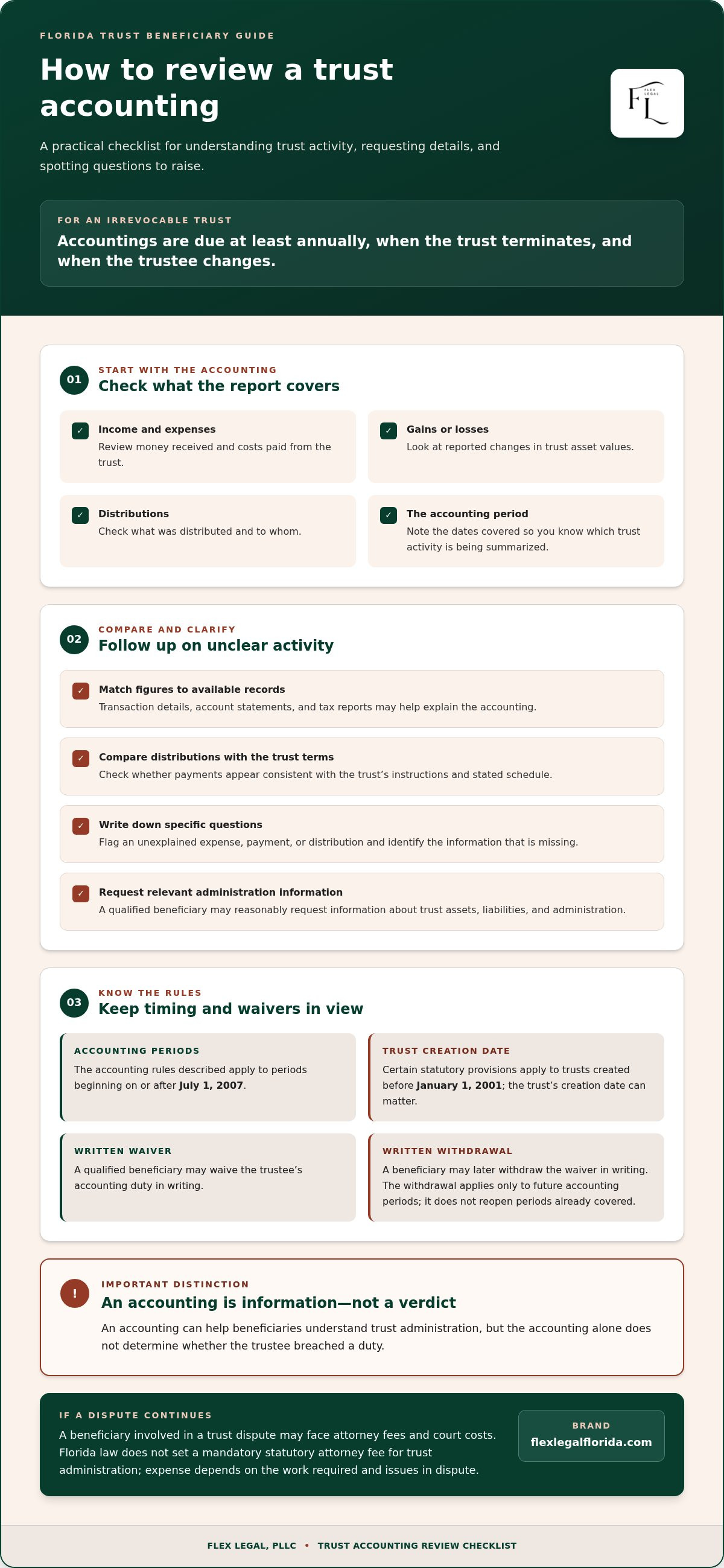
A beneficiary can question how a Florida trustee manages trust assets, especially when records are missing or distributions conflict with the trust’s terms. Florida Statute Section 736.0813 addresses a trustee’s duty to inform and account. Accounting requirements appear in section 736.08135. These rules give beneficiaries a way to understand administration, but an accounting alone doesn’t determine whether a trustee breached a duty.
For an irrevocable trust, the trustee must provide accountings at least annually, when the trust terminates, and when the trustee changes. A qualified beneficiary may also reasonably request relevant information about trust assets, liabilities, and administration. An accounting summarizes income, expenses, gains or losses, and distributions. For example, it can show whether investment income was received and how the trustee used it.
The accounting rules apply to accounting periods beginning on or after July 1, 2007. A qualified beneficiary may waive the trustee’s accounting duty, but the waiver must be in writing. The beneficiary may later withdraw that waiver in writing; the withdrawal applies only to future accounting periods. This distinction matters because ending a waiver doesn’t reopen periods it already covered.
Financial records can help explain the figures in an accounting. A trustee’s records may include transaction details, account statements, and tax reports. If an expense or distribution is unclear, a beneficiary can reasonably request related administration information. Comparing the accounting with the trust terms can reveal questions to raise, such as an unexplained payment or a distribution that seems inconsistent with the stated schedule.
Trust accounting periods also matter for older arrangements. The supplied statutory facts identify July 1, 2007 as the start date for applicable accounting periods, while certain statutory provisions apply to trusts created before January 1, 2001. The trust’s creation date and the accounting period therefore help determine which rules govern a particular record.
Florida law doesn’t set a mandatory statutory attorney fee for trust administration. A beneficiary involved in a trust dispute may face attorney fees and court costs. The work required and issues in dispute affect the expense.
Before escalating a concern, compare the accounting with the trust instrument and note specific unanswered transactions. Florida trust law for beneficiaries gives qualified beneficiaries a way to request relevant financial details. Accurate records can help clarify whether the dispute concerns missing information, administration, or a potential breach.
Does The Trust Provide Protection from Creditor Claims?
A spendthrift provision may protect a beneficiary’s interest in trust assets that remain in the trust after the grantor’s death. Its effect depends on the trust terms and whether the assets remain under the trustee’s control. A beneficiary’s right to future payments, for example, differs from property already distributed. Read the distribution language alongside any creditor-protection clause.
Trust income and principal distributions depend on the trust’s structure. One trust may direct income payments to a beneficiary while preserving principal; another may authorize distributions of both income and principal. The trustee must follow those terms, not withhold or redirect a payment for personal reasons. During administration, accounting records can show what income came in and which distributions were made.
If a trustee delays a distribution, compare the delay with the trust document and the circumstances. Florida trustees must distribute trust assets according to the document unless a valid legal reason supports a delay. An unexplained missed payment may warrant a written request that identifies the relevant provision, expected distribution, and specific delay. This creates a clear record of the concern.
Beneficiaries can enforce a Florida trust by asking the trustee to follow its distribution terms and provide relevant administration information. If informal requests don’t resolve the dispute, a beneficiary may seek court relief, including removal of the trustee or recovery of losses caused by a fiduciary breach. Specific transactions, accounting entries, and trust provisions help explain the remedy sought.
A court can also address a restriction that affects administration. On a party’s motion, and for good cause after notice to interested persons, Florida law allows a court to make an exception to a restriction and authorize the trustee to act or distribute trust assets. The court may impose conditions. This is a court-supervised exception, not an automatic right to an early payment.
For example, a beneficiary might argue that a distribution restriction prevents an action now required by the trust’s circumstances. Before authorizing action, the court considers the motion, good cause, notice, and appropriate conditions. The trustee must still account for any resulting transaction and follow the court’s directions.
When a trustee’s failure to meet their obligations causes a loss to the trust, the trustee may be personally liable for that loss. Preserve relevant accountings, correspondence, and transaction records. These materials can help distinguish a permitted delay from a breach and support a focused request for a distribution, accounting, or recovery.
Notice when a trust becomes irrevocable
A trust’s shift from revocable to irrevocable changes who receives information about its administration. Under Florida Statute Section 736.0813, a trustee must notify qualified beneficiaries within 60 days after a trust becomes irrevocable or a new trustee takes office. The notice duty applies after the trustee acquires knowledge of the trust’s creation or irrevocability. A beneficiary’s informal awareness doesn’t replace the trustee’s formal notice.
The notice must identify the settlor or settlors and explain beneficiaries’ rights to request a copy of the trust instrument and accountings. This information helps a qualified beneficiary understand who created the trust and how to learn about its terms and finances. For example, a beneficiary who hears about a trust from a relative still has the right to the trustee’s formal notice.
The trustee’s notice must also include clear contact information. When accepting a trusteeship, the trustee must provide their full name and address, confirm acceptance, and disclose the fiduciary lawyer-client privilege. Beneficiaries should keep the notice with the trust records and use the trustee’s stated contact details for written requests.
Once irrevocable, a trust generally cannot be revoked or modified by the grantor, except in limited circumstances allowed by Florida law. That does not mean every term is permanently fixed. Florida Statutes Sections 736.04113 and 736.04115 provide for petitions to modify or terminate a trust in certain cases. A beneficiary reviewing a proposed change should distinguish a court-authorized modification from an informal change to administration.
The trust’s creation date can affect notice requirements. Florida’s statutory notice provisions don’t apply to irrevocable trusts created before the effective date of the Florida Trust Code, or to revocable trusts that became irrevocable before that date. The relevant dates are when the trust was created and when it became irrevocable, not simply when a beneficiary first learned about it.
For a new trustee, formal notice matters because it identifies who is responsible for administration. A beneficiary can compare the notice with later accountings and direct questions to the named trustee. If the trustee changes again, the new appointment triggers a separate notice obligation under the statute.
Keep the notice, trust instrument, and later accountings together. These documents help clarify whether the trust is revocable or irrevocable, who currently administers it, and what information beneficiaries may request. A dated written request also creates a useful record if a beneficiary later needs to explain what information they sought.
Trustee impartiality and conflicts of interest
Florida trustees managing a trust with multiple beneficiaries must balance their interests under its terms. This duty is especially important when the trustee’s personal benefit could affect an administration decision.
Impartial Treatment of Beneficiaries
Under Florida Statute §736.0803, a trustee administering a trust with two or more beneficiaries must act impartially and give due regard to their respective interests. Impartiality doesn’t always mean equal distributions. If the settlor directs income to one beneficiary and preserves principal for another, the trustee must respect both interests. Beneficiaries can compare decisions with the trust terms and raise specific concerns about unequal treatment.
Trustee-Beneficiary Conflicts
A trustee-beneficiary has a personal interest in trust decisions but still owes fiduciary duties to all beneficiaries. For example, a trustee who can receive a discretionary distribution must consider the trust’s standards and other beneficiaries’ interests, not simply favor their own benefit. Florida Statute §736.0802 addresses the trustee’s duty of loyalty. Clear records of decisions can help show how the trustee applied the trust terms.
Conflicts can arise even without a direct payment to the trustee. A trustee might decide whether to sell an asset to a business they own, or choose between current income and preserving principal for remainder beneficiaries. In each case, the trust document, beneficiaries’ respective interests, and the trustee’s actions matter. A lawyer can help assess how a specific decision fits the trustee’s fiduciary role.
Out-of-state and international beneficiaries may live far from Florida or communicate across time zones. Distance doesn’t change the trustee’s duty to act impartially. Beneficiaries can keep requests and responses in writing, review the same trust information, and identify a decision that appears to favor one person. For example, a beneficiary abroad can compare a distribution statement with the trust’s stated terms.
Estate planning documents can also shape how conflicts are handled. The settlor’s trust terms may define distribution standards, name successor trustees, or explain how discretion should be exercised. A trustee should apply these instructions consistently, rather than treating a family relationship or a beneficiary’s location as permission to disregard another beneficiary’s interests.
If a conflict affects administration, identify the decision, the trust provision involved, and its effect on each beneficiary. Florida law allows a trust beneficiary to ask a court to remove a trustee. Removal is a court remedy, not an automatic result of a disagreement. The concern should relate to the trustee’s administration or fiduciary conduct.
For help addressing a conflict within trust administration, discuss trust administration concerns and organize the trust terms, accountings, and communications that relate to the disputed decision.
Flex Legal, PLLC: Special Needs Planning
Flex Legal, PLLC helps families address future care and inheritance questions through Special Needs Planning. This can help when a beneficiary with a disability may need trust provisions tailored to their circumstances and existing benefit eligibility. A coordinated plan may also include a Revocable Living Trust, Guardianship Proceedings, or a Last Will and Testament, depending on the family’s goals. These documents serve different purposes, so reviewing how they work together can clarify who manages assets and how future decisions are handled. Families in West Palm Beach facing questions about a trust beneficiary’s needs can connect care considerations with broader estate arrangements. Contact Flex Legal, PLLC to discuss your family’s planning needs.
Take the Next Step With a Plan That Fits
Understanding Florida trust law for beneficiaries can help you ask clearer questions. The next step is connecting those answers to your family’s priorities. Consider what you want a trust to accomplish, who may need support, and how future decisions should be handled. Bringing those goals into one conversation can help turn uncertainty into a practical planning direction.
Flex Legal, PLLC offers Special Needs Planning, Revocable Living Trusts, and Guardianship Proceedings for families working through different estate planning needs. If you’re considering how a trust may fit alongside care planning or future decision-making, share the questions that matter most to your family. Contact Flex Legal, PLLC to discuss your next step. Thoughtful planning can help you move forward with greater clarity and confidence.
Frequently Asked Questions
Can The Trust Hold Title to My Homestead?
A trust may hold title to a Florida home, but the trust arrangement and deed affect how the property is treated. Titling alone doesn’t establish whether homestead protections apply. Review the trust language, ownership structure, and intended use of the home together before transferring title. For a West Palm Beach property, keep the current deed and proposed trust documents available for that review.
What Are The Trustees Responsibilities?
A trustee manages trust property and follows the instructions in the trust document. This may include safeguarding and investing assets, maintaining transaction records, handling taxes and debts, and making distributions as directed. For example, if a trust limits a payment to a stated purpose, the trustee should document how a requested distribution fits that purpose. Responsibilities depend on the trust’s terms and the trustee’s role.
What Are a Beneficiary’s Rights Under Florida Law?
A beneficiary’s rights depend on their interest in the trust and whether it is revocable or irrevocable. A qualified beneficiary may request relevant information about trust assets, liabilities, and administration, and may request a copy of the trust instrument. The trust terms also determine when distributions may be made. If a beneficiary believes administration conflicts with those terms, they can raise the specific concern with the trustee.
What Is Trust Administration?
Trust administration means managing trust property under the trust document. It can involve identifying assets, paying valid debts and taxes, keeping transaction records, and carrying out distributions. For example, after a grantor’s death, a successor trustee may need to identify accounts titled in the trust before distributing them to beneficiaries. Administration follows the trust’s instructions and differs from handling assets through probate.
What rights do beneficiaries have under Florida trust law?
Beneficiaries’ rights depend on their present or future interest and the trust’s status. A remainder beneficiary, for example, may have an interest in what remains after another beneficiary’s current interest ends. Qualified beneficiaries may request information and accountings under applicable rules. Beneficiaries may also seek court relief if a trustee breaches fiduciary duties, including removal or recovery of losses caused by the breach.
What information and accountings must a Florida trustee provide beneficiaries?
A qualified beneficiary may reasonably request information about trust assets, liabilities, and administration, as well as a complete copy of the trust instrument. For an irrevocable trust, accountings generally summarize income, expenses, gains or losses, and distributions. Accountings are due at least annually, when the trust terminates, and when the trustee changes. Comparing an entry with the trust terms can help clarify an unexplained transaction.
When must a Florida trustee notify beneficiaries about a trust or trustee change?
A trustee generally must notify qualified beneficiaries within 60 days after accepting a trust, after the trust becomes irrevocable, or after a new trustee takes office. The notice provides key information about the trust and trustee, helping beneficiaries understand who administers it and how to make requests. A beneficiary who learns informally about a change should still look for the trustee’s formal notice and retain it with trust records.
What fiduciary duties does a trustee owe beneficiaries under Florida law?
A trustee must administer the trust according to its terms, manage trust property carefully, and act loyally toward beneficiaries. When a trust has multiple beneficiaries, the trustee must act impartially and give due regard to their respective interests. For example, when balancing current income for one beneficiary against preserving principal for another, the trustee should follow the document’s directions and clearly record the decision.



Comments