
Florida statutory probate fees explained, including costs

A Florida probate fee schedule is a benchmark, not automatically a fixed bill. According to the Florida Legislature, the presumptively reasonable attorney fee is $1,500 for a compensable estate value from $0 to $40,000; in a formal administration, the schedule applies 3% to the next $900,000 above $100,000. This guide explains Florida statutory probate fees in practical terms, including how the schedule works as estate values rise.
It’s understandable to want a reliable estimate before probate costs begin to add up. The total can include more than attorney fees: the personal representative may also be entitled to compensation. Knowing how these amounts are calculated makes it easier to plan for the process.
This article explains how statutory attorney fees differ from total probate costs, how personal representative compensation works, and which expenses can affect estates of different sizes. The examples show what the fee schedule can indicate and where an estate’s specific circumstances matter.
Table of Contents
How Much Does Probate Cost in Florida?
Florida statutory probate fees explained through the tiered schedule provide a benchmark for estimating ordinary attorney compensation, not an automatic fixed bill. Total probate costs also depend on the type of administration and expenses such as court filings or appraisals.
Ordinary Attorney Compensation
Ordinary compensation covers an attorney’s routine legal work during estate administration. According to the Florida Legislature, the presumptively reasonable probate attorney fee for a compensable estate value of $0 to $40,000 is $1,500. This benchmark helps families understand one part of the estimate; the attorney and personal representative may agree to a different reasonable fee arrangement.
How Statutory Attorney Fees Are Determined
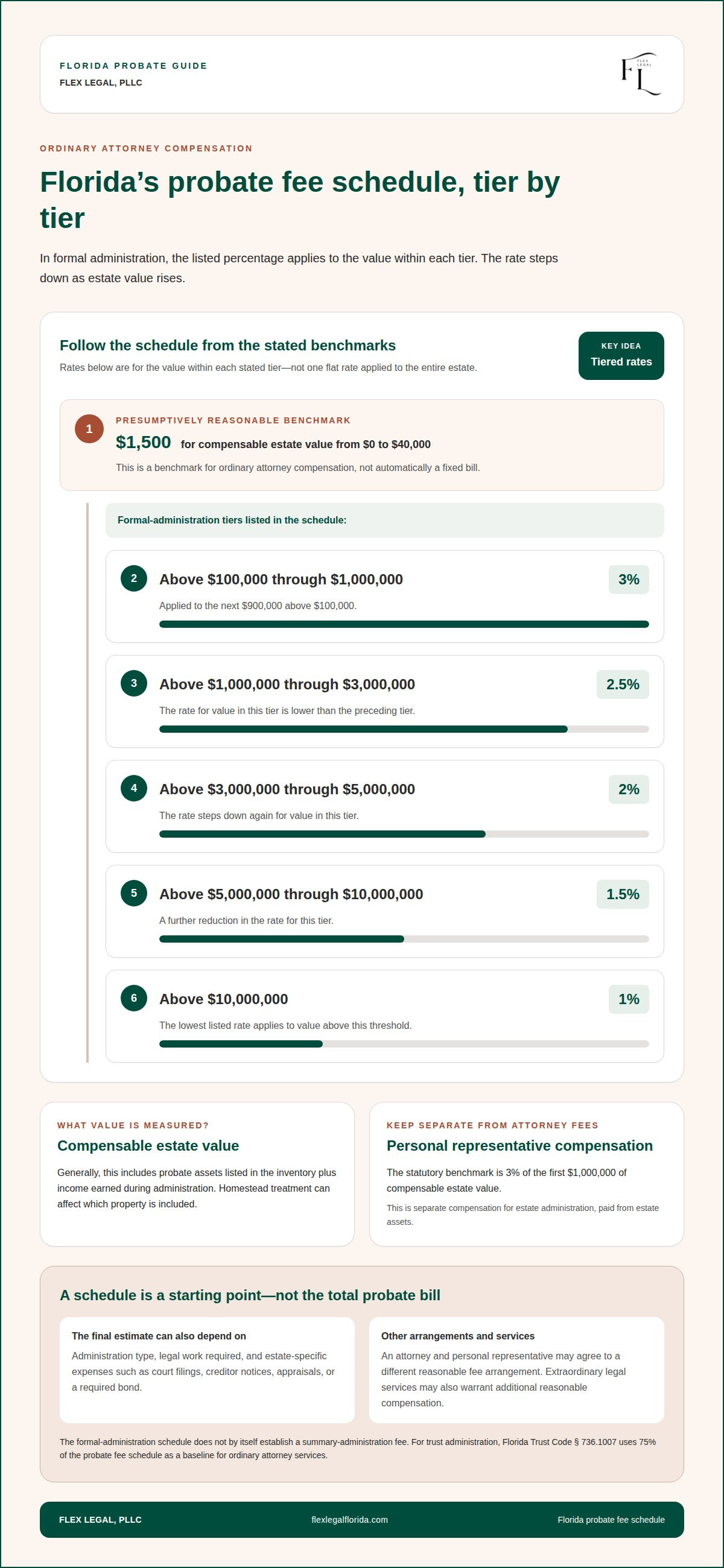
The schedule calculates ordinary attorney compensation in stages, applying each rate to the value within its tier. According to the Florida Legislature, formal administration applies 3% to the next $900,000 above $100,000; 2.5% above $1 million through $3 million; 2% above $3 million through $5 million; 1.5% above $5 million through $10 million; and 1% above $10 million.
Compensable value generally includes the value of probate assets listed in the inventory, plus income earned during administration. The tier structure matters because the rate decreases as the estate value rises.
Fees Across Administration Types
Summary and formal administration involve different procedures, so attorney compensation depends partly on the legal work required. The formal-administration schedule does not by itself establish a summary-administration fee. For trust administration, Florida Trust Code § 736.1007 uses 75% of the probate fee schedule as a baseline for ordinary attorney services.
Fee Petitions and Governing Requirements
Florida Statutes § 733.6171 addresses attorney compensation, while § 733.617 covers personal representative compensation. An interested person may petition the court to adjust ordinary-service compensation or seek payment for extraordinary services when circumstances warrant it.
Florida’s 2021 amendments to § 733.6171 strengthened attorney disclosure requirements before statutory-schedule fees are charged. The original will must be deposited with the court clerk within 10 days of learning of the testator’s death, according to Florida law; this is a will-deposit deadline, not a fee-petition deadline. Florida statutory probate fees explained by their tiers provide a starting point, while negotiated hourly or flat-fee arrangements can differ.
Personal representative compensation
A personal representative’s compensation is separate from attorney fees and is paid from estate assets. Its statutory benchmark helps families distinguish payment for administering an estate from charges for legal work.
Compensable Estate Value
Compensable estate value is the measure used to calculate presumed reasonable compensation. According to the Florida Legislature, the presumed reasonable personal representative fee is 3% of the first $1,000,000 of compensable estate value. The value generally reflects probate assets listed in the inventory, plus income earned during administration.
Homestead treatment can affect which property is included in the probate calculation. The home’s status and whether it is treated as exempt matter when determining estate value; summary administration also has eligibility rules that account for homestead. As a result, the personal representative’s compensation is not necessarily a percentage of everything the decedent owned.
Additional Compensation for Extraordinary Services
Extraordinary services are tasks beyond routine estate administration that may warrant additional reasonable compensation. Florida law allows an attorney representing a personal representative to receive further reasonable compensation for extraordinary services, in addition to fees for ordinary services.
Examples may include resolving a will contest, handling an audit, or addressing disputes over the personal representative or asset distribution. The circumstances and work involved determine whether additional compensation is appropriate. Keep that amount separate from the representative’s own compensation when estimating professional fees for the estate.
Professional fees can include both the personal representative’s compensation and attorney fees. The representative manages the administration, while the attorney provides legal services. Their statutory schedules are separate, even when both calculations use compensable estate value. This distinction matters in summary administration as well as formal proceedings.
Statutory amounts are not the only possible arrangement. An attorney and personal representative may agree to an hourly or flat-fee structure, which can make budgeting more predictable when the work is clearly defined. The fee basis, scope of work, and any extraordinary tasks all affect the estimate. A notice or public filing may also be required during administration, but it is not compensation.
For future planning, a durable power of attorney can address who may act during incapacity, a separate issue from probate compensation.
Estimated costs for small, mid-size, and complex estates
Total probate costs combine legal compensation, court charges, and estate-specific expenses. For a useful estimate, separate these items rather than relying on estate value alone.
Estate Value and Work Involved
Estate value helps establish fee estimates, but the assets and tasks determine how much work administration requires. A straightforward estate with a few accounts may take less work than one involving multiple properties, business interests, or disputes, even if their values are similar.
The decedent’s mix of assets and any unresolved issues help explain why totals vary.
Filing Fees and Other Estate Expenses
Other expenses may include creditor notices, certified Letters of Administration, appraisals, and a bond if the court requires one.
For a required bond, the premium is typically 0.5% to 1% of estate value per year. If a federal estate tax return is prepared, presumed reasonable attorney compensation may be one-half percent on value up to $10 million, then one-fourth percent on gross estate value above $10 million.
Estimating Total Probate Costs
Build an estimate by adding the filing charge for the chosen type of administration, attorney compensation, any personal representative fee, and likely estate expenses.
Attorney fees and personal representative compensation are paid from estate assets, while valid creditor claims are paid before beneficiaries receive distributions. Listing expected filings, notices, appraisals, tax work, and creditor claims gives families a clearer working budget.
Florida statutory probate fee schedule
The schedule is a tiered benchmark for a probate attorney’s ordinary services, not a flat percentage applied to the entire estate. Each rate applies only to the value within its tier, so higher estate values move into lower percentage brackets.
For example, the schedule’s first $100,000 corresponds to a $3,000 attorney fee. These examples illustrate how the initial 3% calculation works, rather than adding separate expenses or personal representative compensation.
Above the first $1 million, the percentage decreases by tier: 2.5% applies above $1 million through $3 million, 2% above $3 million through $5 million, 1.5% above $5 million through $10 million, and 1% above $10 million, according to the Florida Legislature. Those percentages apply to the value in each stated range, not retroactively to the entire estate. This marginal approach prevents a larger estate’s lower-tier amounts from being recalculated at its highest bracket.
“Presumptively reasonable” means a benchmark, not an amount every probate attorney is automatically entitled to charge. Attorney fees remain negotiable. Separate ordinary services from extraordinary work and other estate expenses, and remember that the inventory value and income earned during administration affect the compensable value used in the calculation.
Beneficiaries can use the schedule to understand the attorney-fee component, then account separately for filings, creditor notices, appraisals, and any personal representative compensation. County filing charges and other costs are distinct from the statutory attorney percentage. For support with the administration and its fee calculations, get help with Florida probate administration.
Flex Legal, PLLC: Probate Administration
Flex Legal, PLLC provides Probate Administration for families handling an estate in Florida, including West Palm Beach. Turn to the firm for help understanding the administration process, organizing estate matters, or determining how attorney and personal representative compensation fit into the estate’s obligations. Clear legal guidance can help you understand the issues affecting the estate before assets are distributed.
If probate planning is part of a wider family plan, related options may include a Revocable Living Trust, a Last Will and Testament, or Guardianship Proceedings. The right approach depends on your goals and circumstances. Contact Flex Legal, PLLC to discuss probate administration and the questions affecting your family.
Plan your family’s next steps
Now that Florida statutory probate fees are explained, you can move from estimating expenses to deciding what support your family needs. Consider the estate’s immediate administration alongside longer-term priorities, such as supporting a loved one with additional needs or planning for future guardianship.
Flex Legal, PLLC provides Probate Administration, Special Needs Planning, Revocable Living Trusts, and Guardianship Proceedings in West Palm Beach. These services address different needs, from managing an estate after a death to preparing for future family circumstances. A focused conversation can clarify which legal matters are relevant to your situation and what information will guide the next steps.
Contact Flex Legal, PLLC to discuss your probate or planning needs and move forward with greater clarity.
Frequently Asked Questions
Who Pays Probate Costs?
Probate costs are generally paid from estate assets during administration. The personal representative arranges payment, and valid creditor claims are paid before beneficiaries receive distributions. Outstanding debts and administration expenses, for example, reduce the assets available to distribute. Beneficiaries typically receive what remains after those obligations are addressed, rather than paying the estate’s costs directly at the outset.
What Court Costs and Filing Fees Apply in Broward, Miami-Dade, and Palm Beach County?
Filing expenses depend on the type of petition and the applicable court charges. Creditor-notice publication and document copies can add expenses. Keep court and publication charges separate from attorney compensation when estimating the total.
Who is Involved in the Probate Process?
The personal representative manages the estate, with a probate attorney providing legal representation. The court clerk receives filings, and the court handles matters requiring judicial action. Creditors may submit claims, while beneficiaries or heirs receive distributions after obligations are addressed. For example, resolving a disputed creditor claim may involve the representative, attorney, creditor, and court before distributions proceed.
How are Florida probate attorney fees calculated under Florida Statutes § 733.6171?
Florida Statutes § 733.6171 provides the framework for attorney compensation in estate administration. The presumed reasonable schedule uses compensable value, generally based on probate-asset inventory value plus estate income during administration, and applies rates by value tier. That calculation is distinct from personal representative compensation under § 733.617. An attorney and personal representative may agree to a different fee arrangement, subject to applicable requirements.
What are the Florida statutory attorney fee amounts by estate value?
The presumptively reasonable amounts are $1,500 for compensable value from $0 to $40,000, $2,250 from $40,001 to $70,000, and $3,000 from $70,001 to $100,000. Above $100,000, the schedule applies 3% to the next $900,000, then 2.5% above $1 million through $3 million, 2% through $5 million, 1.5% through $10 million, and 1% above $10 million.
Which probate services are included in Florida’s presumptively reasonable attorney fees?
The presumed fee relates to ordinary legal services for estate administration. Probate representation can include court proceedings, creditor notifications, and asset distribution. Work beyond ordinary administration, such as a will contest or another dispute, may involve extraordinary services and additional compensation. This distinction helps explain why the ordinary-service calculation may not cover every legal task an estate requires.



Comments