
Florida Guardianship Alternatives for Supporting Adult Decisions

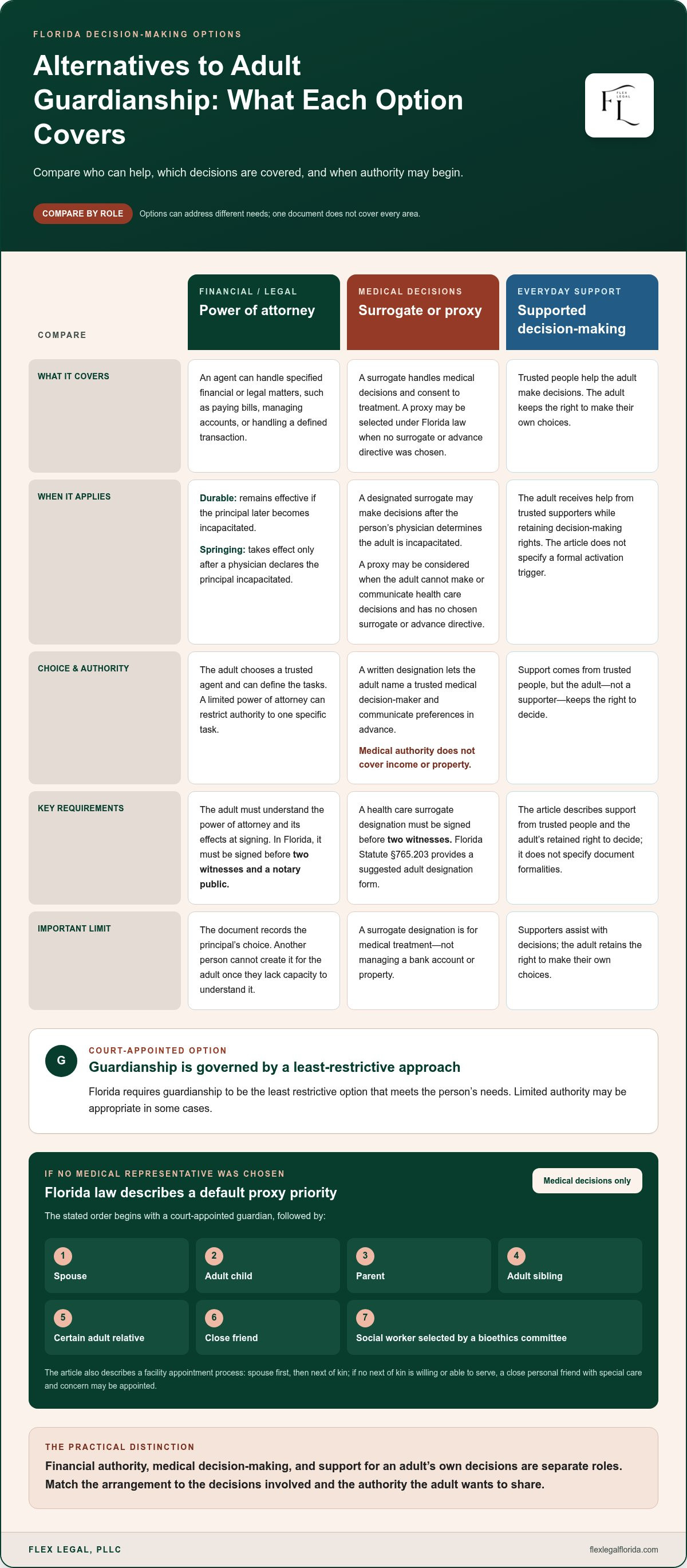
A court-appointed guardian isn’t the only way to support an adult’s decisions in Florida. Florida guardianship alternatives for adults can include a durable power of attorney for financial matters, a health care surrogate or proxy for medical decisions, and supported decision-making, where the adult keeps the right to decide with help from trusted people. Each option has a different role and scope.
It’s understandable to want support that protects someone while preserving as much independence as possible. The right arrangement depends on the decisions involved, the support the adult needs, and whether they can make and communicate their own choices.
This article explains how Florida guardianship alternatives for adults work, what they can and can’t cover, and how their benefits and limits compare with guardianship. It also explains how Florida’s least-restrictive approach shapes the available options, helping you assess what may fit your circumstances.
Table of Contents
What Are the Alternatives to Guardianship?
Florida guardianship alternatives for adults include documents that assign specific financial or medical responsibilities without first appointing a guardian through court. The right approach depends on which decisions need support and how much authority the adult wants to share.
Durable and Springing Powers of Attorney
A durable power of attorney authorizes an agent to handle financial or legal matters and remains effective if the principal later becomes incapacitated. Florida’s statutory definition is cited in Section 709.2102, F.S.; the durable power of attorney law is also cited as F.S.§709.08.
A power of attorney lets someone choose a trusted representative to pay bills, manage accounts, or handle a specific transaction. A limited power of attorney can restrict authority to one defined task. In Florida, the document must be signed before two witnesses and a notary public.
A springing power of attorney takes effect only after a physician declares the principal incapacitated. This delayed authority may suit someone who wants an agent to act only after a specified event. The document should clearly state the agent’s powers and the condition that activates them.
When comparing Florida guardianship alternatives for adults, focus on when authority begins and which tasks it covers. A broad power of attorney and one limited to a particular transaction serve different needs.
Capacity to Execute a Power of Attorney
The person signing must have the mental capacity to understand the power of attorney and its effects at the time of signing. This requirement matters because the document records the principal’s choice, not a family member’s decision to take control.
For example, a parent may understand and authorize an agent to manage banking while needing help with complex paperwork. The document can define the agent’s authority, but another person cannot create it for the adult once they lack capacity to understand it.
Before signing, the adult should understand who the agent is, which tasks the agent may handle, and whether the authority continues during incapacity. Clear limits help the representative follow the adult’s wishes instead of assuming broader control.
Advance Directives and Establishment Steps
An advance directive records medical preferences or names someone to make health care decisions. A living will can state wishes about care during terminal illness or a vegetative state. A health care surrogate designation names someone to make decisions about medical treatment.
To establish either document, identify the decisions involved, choose a trusted representative, and put the instructions in writing. Florida Statute §765.203 provides a suggested adult health care surrogate designation form. The designation must be signed before two witnesses. A power of attorney also requires two witnesses and a notary public.
Costs depend on the documents’ scope and drafting complexity, and are provided after a quote request. Pairing financial authority with medical instructions can address separate needs, but each document covers its own area. A health care surrogate handles medical decisions, not income or property.
These documents can work together without giving one representative authority over every aspect of someone’s life. That tailored scope is central to choosing Florida guardianship alternatives for adults.
Health care surrogates and proxies
Florida adults can plan who will help make medical decisions if illness or injury leaves them unable to decide or communicate. A written designation and a default proxy are different ways to address that need.
Healthcare Surrogate Designations
A health care surrogate designation names someone to make medical decisions when the adult cannot make them. Florida Statute §765.102 recognizes every competent adult’s right to choose or refuse medical treatment. Florida Statute §765.203 provides a suggested designation form for adults, and the document must be signed before two witnesses.
A written designation identifies the person the adult trusts before a medical crisis. A designated surrogate may make decisions and consent to treatment after the person’s physician determines that the adult is incapacitated. The document lets the adult name a representative and communicate preferences in advance.
A surrogate’s authority covers medical treatment and consent, not the adult’s income or property. For example, a surrogate may discuss treatment options with clinicians but cannot use the designation to manage a bank account. During incapacity, the surrogate may also apply for aid such as Medicare on the adult’s behalf.
Healthcare Decision-Making Supports
Under Florida law, a health care proxy may be selected when an adult cannot make or communicate health care decisions and has no chosen surrogate or advance directive. The stated priority begins with a court-appointed guardian, followed by a spouse, adult child, parent, adult sibling, certain adult relative, close friend, and a social worker selected by a bioethics committee.
When a Florida health care facility appoints a proxy because no prior designation exists, the spouse receives first consideration, followed by next of kin. If no next of kin is willing or able to serve, a close personal friend with special care and concern may be appointed. This default process matters when an adult has not documented a preferred representative.
These options support medical decisions, not every area of daily life. An adult with disabilities may benefit from choosing a surrogate who understands their communication style, health history, and values. Families can discuss likely choices in advance, including who should receive medical information and how the adult wants treatment decisions approached.
A clear designation can reduce uncertainty about who speaks during a medical crisis. Adults planning their documents can consider a health care surrogate designation that reflects their preferred decision-maker and medical instructions.
Supported decision-making
Supported decision-making lets an adult make choices with help from people they trust, rather than transferring decision-making authority. To challenge or end a guardianship, raise the concern with the court overseeing it; Florida courts may dismiss guardians who abuse or neglect their duties. For lower-cost legal help, contact Florida legal aid programs and ask about eligibility for guardianship-related assistance.
Supported Decision-Making Agreements
A supported decision-making agreement records how chosen supporters help an adult understand options and communicate decisions. Unlike a guardian, a supporter doesn’t take over the adult’s final decisions or responsibility for their consequences. This distinction matters when someone wants practical help while retaining legal control over their choices.
An agreement can address financial, health care, housing, or transportation decisions. A written document may define supporters’ responsibilities, the adult’s rights, and the information supporters can access. Arrangements can also remain informal or combine written terms with everyday support. The adult should trust each supporter to respect their wishes and values.
The adult with a disability may end an agreement or remove a supporter at any time and for any reason. This flexibility helps keep support responsive as needs and relationships shift. For example, someone may welcome help reviewing medical options but prefer another supporter for financial decisions.
Resources for Supported Decision-Making
State-by-state resources explain local supported decision-making approaches because guardianship standards and protections differ between states. Florida made supported decision-making more prominent through legislation signed in 2024. Any written arrangement should reflect the adult’s preferences and the decisions where support is useful.
For legal help with an existing guardianship or planning alternatives, Florida legal aid programs provide a starting point for asking about eligibility and available assistance. Explain whether the concern involves changing guardianship authority, ending an appointment, or preparing decision-making documents. The court overseeing a guardianship can address concerns about a guardian’s conduct.
Supported decision-making may help an adult who can make choices with accessible explanations, time, or communication assistance. It differs from a guardianship finding that someone is incapacitated and needs an appointed guardian for certain decisions. Supporters can have a defined role without receiving final authority.
Florida’s Agency for Persons with Disabilities also has client advocates who may participate in decisions about APD services. An advocate can contribute to discussions but has no legal authority to make those decisions. This distinction helps families separate advocacy from formal decision-making power.
Before choosing supporters, identify the decisions where help is needed and the information each person may access. A clear agreement can cover health care appointments, comparing housing options, or understanding a financial document. The adult remains the decision-maker, and the arrangement can change as support needs do.
Less restrictive alternatives to guardianship
Florida courts must consider whether a less restrictive option can meet an adult’s needs before appointing a guardian. The appropriate option depends on the decisions involved, such as managing benefits, assets, or health care affairs.
Florida guardianship law was revised in October 1989 to require that no least restrictive alternative be available before a court appoints a guardian. The requirement appears in F.S.§744.331(6)(b). If an alternative adequately addresses some needs, the court cannot delegate those covered rights to a guardian.
That principle can preserve authority over areas where an adult can still decide. For example, a person may need help managing Social Security payments but remain able to choose where to live. Florida law favors limited guardianship, which grants authority only in areas where the person lacks capacity. Limited guardianship is addressed in Section 744.2102, F.S.
A Social Security representative payee manages benefits for the beneficiary rather than taking control of all personal affairs. The Social Security Administration appoints the payee to receive Social Security checks or SSI benefits. The payee uses funds for current and future needs, saves unneeded benefits, and keeps expense records. Section 402.33, F.S., is cited in connection with managing and using Social Security benefits.
This focused role can address benefit management without transferring unrelated decision-making powers. For instance, a representative payee may manage benefit payments while the adult continues making choices about health care or housing. The arrangement concerns Social Security benefits, not every source of income or property.
A special needs trust can hold funds under a trustee’s control, with the beneficiary unable to access the money directly. This structure separates management of trust assets from broader decisions about the beneficiary’s life. A revocable living trust can also name a successor trustee to manage assets if its grantor becomes unable to do so.
Trusts can address asset management, but they don’t automatically replace every guardianship function. A trustee’s role concerns trust property, while a guardian may receive authority over personal or property decisions assigned by the court. The right document depends on which affairs need support and which decisions the adult can continue to make.
To assess a less restrictive alternative, identify the specific task causing concern, then match it to a focused tool. A representative payee may fit benefit management, a trust may address assets, and a limited guardianship may cover defined areas of incapacity. Florida’s least-restrictive requirement makes that distinction central to the court’s decision.
Benefits and risks of guardianship alternatives
Alternatives can preserve an adult’s control over decisions and limit authority to specific needs. Their value depends on the task: a health care surrogate addresses medical decisions, while a trust can focus on assets. The key tradeoff is scope. A focused tool may avoid transferring broader rights, but it won’t cover decisions outside its purpose.
A durable power of attorney can let a chosen agent manage financial and legal matters if the principal becomes incapacitated, potentially avoiding a court appointment for those tasks. The document’s wording defines the agent’s authority. If it grants power over matters the adult wants to manage, that authority may be broader than intended.
Health care planning offers a separate benefit. A designated surrogate can make medical decisions after a physician determines the adult is incapacitated. A living will can record preferences for care during terminal illness or a vegetative state, helping loved ones understand the person’s wishes. These medical documents don’t authorize someone to manage assets or income.
Supported decision-making can provide help without transferring final decision-making authority. An adult may choose trusted supporters to help understand health care options, housing choices, or financial information while keeping responsibility for decisions. This model relies on supporters respecting the adult’s choices, and the adult may end the agreement or remove a supporter at any time.
Trusts may provide private asset management without court involvement or judicial approval. A revocable living trust can name a successor trustee to manage assets if the grantor becomes unable to do so. A trust governs trust property, not every personal or medical decision. Its value depends on which assets it holds and the trustee’s defined role.
Guardianship may provide court-supervised authority when other arrangements don’t address the adult’s needs. Florida guardians must file annual plans and accountings while the guardianship remains in effect. This oversight brings reporting duties, and guardianship may limit the ward’s ability to make important life decisions. A limited guardianship confines authority to areas where the court finds the person unable to decide.
Compare each option against the specific concern: medical choices, benefit management, or broader care. If the adult can make some decisions but needs help with others, combining documents and support may preserve more rights. If a court process is necessary, limited authority may fit better than transferring every delegable right.
For families coordinating disability-related needs with future decision-making, explore special needs planning as part of a tailored plan.
Flex Legal, PLLC: Special Needs Planning
Flex Legal, PLLC helps West Palm Beach families coordinate Special Needs Planning with estate documents and decisions about future support. This can be useful when an adult needs ongoing assistance, family members are considering a trust, or guardianship may need to be addressed. The plan can connect a Revocable Living Trust with a Last Will and Testament while accounting for the individual’s needs and the family’s priorities.
If an existing or potential court appointment is part of the picture, Guardianship Proceedings may also be relevant. The goal is to understand how each planning tool fits, rather than assume one document covers every decision.
To discuss special needs planning for your family, contact Flex Legal, PLLC.
Shape a Plan Around the Adult’s Priorities
Start by discussing what the adult wants to decide independently, where support would help, and whom they trust to provide it. Those preferences can guide a plan that fits real life rather than relying on a one-size-fits-all arrangement. Florida guardianship alternatives for adults work best when the chosen supports match the specific decisions at hand.
Flex Legal, PLLC can help families consider how Special Needs Planning, Revocable Living Trusts, and Guardianship Proceedings fit into broader planning. The focus is on aligning legal tools with the adult’s needs and family priorities while keeping the plan adaptable as circumstances change.
If you’re ready to discuss the options for your family, contact Flex Legal, PLLC. A thoughtful next step can make future decisions clearer and help your family move forward with greater confidence.
Frequently Asked Questions
When is a guardian required?
A Florida court may appoint a guardian after finding an adult incapacitated and determining guardianship is necessary. The court considers whether the person can manage property or meet essential health and safety requirements, and whether a less restrictive alternative can address those needs. For a West Palm Beach family, the issue may be specific, such as managing finances, rather than every personal decision. The court’s order defines the guardian’s authority.
What Is Adult Guardianship in Florida?
Adult guardianship is a court-supervised arrangement that authorizes another person to make decisions within powers granted by the court. Florida guardianship law is in Chapter 744 of the Florida Statutes. The court determines which rights the guardian may exercise, and guardianship remains subject to oversight. For example, a guardian may have authority over a particular property matter, while other rights remain with the adult under the court’s order.
Why Avoid Full Guardianship?
Full guardianship can transfer decision-making authority across areas where an adult may still be able to make choices. Florida Statutes Section 744.3215 addresses rights an incapacitated person may lose. A narrower plan may better fit someone who needs help with finances but can express medical or housing preferences. The practical question is which decisions require another person’s authority, not whether help is needed in every part of life.
What alternatives to adult guardianship are available in Florida?
Florida alternatives include a durable power of attorney, a health care surrogate designation, supported decision-making, and arrangements focused on particular assets or benefits. For example, a successor trustee can manage trust assets if the grantor becomes unable to do so, while a Social Security representative payee handles benefit payments. Each option has a defined scope, so families can match support to the decisions or resources involved.
How do Florida powers of attorney and health care surrogate designations work?
A power of attorney authorizes an agent to handle the financial or legal matters described in the document. The signer must understand the document and its effects, and Florida requires signing before two witnesses and a notary public. A health care surrogate designation addresses medical decisions instead. Families may coordinate both documents so one representative handles finances and another supports health care decisions.
Can a Florida adult use a living will or advance directive instead of guardianship?
A living will can record medical preferences if an adult later cannot make decisions, including wishes concerning terminal illness or a vegetative state. It applies while the person is alive, unlike a Last Will and Testament. It doesn’t address financial affairs or appoint someone to manage all personal decisions. A health care surrogate designation can name a medical decision-maker, providing separate support.
What supported decision-making options are available to adults in Florida?
An adult can choose trusted supporters to help understand information, consider options, and communicate decisions. The arrangement may be informal, written, or a combination. A written agreement can describe what information supporters may access and which decisions they help with, such as reviewing housing choices or preparing for a health care appointment. The adult keeps final decision-making authority and may end the agreement or remove a supporter at any time.
When can a Florida court appoint a guardian, and what less restrictive alternatives must it consider?
A court may consider guardianship after a judicial finding that an adult lacks capacity to manage at least some property or meet essential health and safety needs. Under F.S.§744.331(6)(b), Florida law requires consideration of the least restrictive alternative. The court can assess whether documents or focused arrangements address particular needs. If an alternative adequately covers some needs, the court cannot delegate those same rights to a guardian.



Comments